
Smart Buys
What $40 vs. $400 Frames Actually Buy You
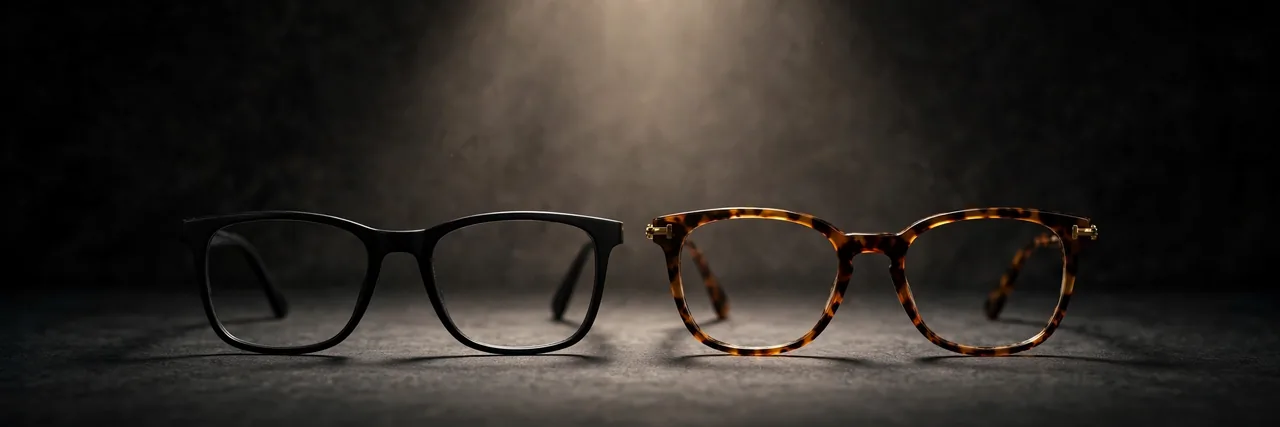
Few people in eyewear want to have this conversation honestly — not the brands, not the retailers, and definitely not the conglomerate that makes both the "cheap" and "expensive" options. So we'll have it: what your money actually buys at $40, $150, and $400, and where the markup really lives.
The question behind the question
"Why are glasses so expensive?" goes viral every eighteen months like clockwork — the Forbes pieces, the TruTV segments, the 60 Minutes lineage. Fact-checkers land somewhere between the "10% markup" and "80% markup" claims, and the truth is less a single number than a structure. EssilorLuxottica sits astride the whole industry — frames, lenses, retail chains and eye-care insurance under one roof, by far the largest player in global eyewear. When one company touches that much of the supply chain, the brand, the shelf, and in many cases the payment rail, "expensive" stops being a simple question of manufacturing cost.
What the viral takes miss: price tiers in eyewear are real, even if the markups are inflated. A $40 frame and a $400 frame are genuinely different objects. The differences just aren't where the marketing says they are. Let's go tier by tier.
The $40 tier: the honest minimum
At $40 — the Zenni-style online value tier that keeps compressing optical retail margins, per Fact.MR's 2026 outlook — here's what you're buying:
- Materials: basic acetate or injected plastic, standard metal alloys. The acetate is thinner stock, simpler lamination — one or two color layers rather than the deep multi-layer blocks of premium frames. It'll look fine. It won't have the depth of color you see when you hold a premium frame to the light.
- Hinges: standard barrel hinges, usually three or five barrels, sometimes with a spring mechanism. Functional. The failure point, if there is one, will be here — cheaper hinge screws loosen faster and the barrels wear with repeated folding.
- Finish: machine-polished, sometimes tumble-polished. Edges are fine; they're not hand-beveled. You'll rarely see hand-finishing at this price, and that's the honest tradeoff of automation.
- Lenses: basic single-vision plastic (CR-39 or basic polycarbonate) with standard coatings. This is where the $40 tier's real economics live — the frame is the hook; the lens upsells (thinner materials, premium anti-reflective, blue-light filters) are where budget retailers make their margin.
Verdict: The $40 tier is genuinely good value for simple prescriptions and backup pairs. The frame will do its job. What you're not getting: refined materials, hand finishing, or hinge engineering that survives years of daily abuse. For a lot of people, that's a completely fair trade. We mean that — this isn't a "you get what you pay for" scold. It's the rational baseline.
The $150 tier: the sweet spot nobody markets
Somewhere around $150 — think Warby Parker's classic pricing band (the company did $871.9M in revenue in FY2025, mostly at this tier) — the value equation changes more than the marketing admits:
- Materials: noticeably better acetate — richer laminations, more color depth, often from name acetate producers. Metal frames move into better stainless steel and entry titanium. The difference between $40 acetate and $150 acetate is visible to the naked eye in a way the $150-to-$400 jump often isn't.
- Hinges: better-engineered barrels, more consistent spring hinges, tighter tolerances. The frame opens and closes with a feel you can actually perceive — that small, satisfying precision is real engineering, not placebo.
- Finish: better polishing, cleaner edges, more consistent color. Some hand-finishing enters at this tier, particularly on the inside of temples and around the lens groove where machines leave marks.
- Lenses: better base lens materials become standard or affordable; anti-reflective coatings improve meaningfully. The upsell ladder still exists, but the starting rung is higher.
- What you're also buying: try-on programs, easier returns, in-store adjustments, eye exams in ~90% of Warby Parker stores. Service infrastructure costs money, and at this tier you're funding some of it.
Verdict: This is the tier we'd point most people to. The jump from $40 to $150 buys you more real improvement — in materials, hinges, finish, and service — than the jump from $150 to $400 does. Diminishing returns start here, and they're steep. If someone asks us "what should I actually buy," the honest answer for most faces and most prescriptions starts at this tier.
The $400 tier: what the extra $250 buys (and doesn't)
At $400 — designer licenses, luxury houses, premium independents — you're paying for a mix of real craft and real markup. Separating them is the whole game:
- What the money genuinely buys: premium acetates (Mazzucchelli 1849 and similar — the good stuff, with deep multi-layer color); titanium and beta-titanium in the metal frames; genuinely superior hinge engineering (multi-barrel, sometimes seven-layer hinges on Japanese frames); hand-finishing — hand-polishing, hand-beveling, hand-engraving — that machines can't replicate; and tighter quality control with lower tolerance for defects.
- What the money also buys: the brand name on the temple. Designer licensing economics mean a meaningful slice of that $400 goes to the fashion house whose logo is on the frame, not to the factory that made it. The frame underneath a luxury license is often made in the same facilities, on the same lines, as frames costing half as much.
- The craft exception: independent makers — the Japanese workshops of Sabae, small European ateliers — at this price are selling something structurally different: small batches, extensive handwork, proprietary materials. A $400 independent frame and a $400 licensed-designer frame are not the same product wearing different logos. The independent one typically puts more of your money into the object.
Verdict: $400 can be worth it — for genuine craft, exceptional materials, and frames built to be repaired rather than replaced. It's rarely worth it for the logo alone. The question to ask at this tier isn't "is it nice" (it will be) but "where did my $250 over the mid-tier go — into the frame, or into the license?"
Where the markup actually lives
Let's be blunt about the economics, because this is the part the industry won't say out loud:
- Licensing. Designer eyewear licenses are rent-seeking on a logo. The fashion house designs little, manufactures nothing, and collects. This is the single biggest "paying for nothing tangible" component in the $300+ tier.
- Retail overhead. The 18,000 stores in EssilorLuxottica's network, the opticians' salaries, the rent on high streets — someone pays for the store you tried the frames on in. Online DTC exists largely to route around this cost, which is why the $40–$150 tiers live online.
- Lens upsells. The frame gets you in the door; the lenses are where margin stacks. The jump from basic 1.5-index plastic to 1.67 or 1.74 high-index, plus premium anti-reflective and specialty coatings, can double or triple the ticket. Some of that is real material cost. A lot of it is margin with a coating brand name on it.
- Marketing. Celebrity campaigns, fashion-week presence, flagship stores as art installations (Gentle Monster's stores are galleries that happen to sell glasses). You're funding the world-building.
- Actual manufacturing cost. Here's the uncomfortable truth: the factory cost difference between a decent $40 frame and a decent $150 frame is real but modest. Between $150 and $400, the manufacturing delta shrinks further while the price delta grows. The curve of "what you get" flattens; the curve of "what you pay" doesn't.
The lens upsell decoder
Since lenses are where the real money moves, here’s the quick honest guide:
- 1.50 / 1.57 / 1.59 (standard): fine for mild prescriptions (±2.00 and under). Don't let anyone upsell you past this if your prescription is light — the visual difference is negligible and the price difference isn't.
- 1.67 high-index: the rational choice for moderate-to-strong prescriptions (±2.00 to ±6.00ish). Meaningfully thinner and lighter. Worth paying for.
- 1.74 high-index: for strong prescriptions (±6.00+). Thinnest available in standard optics. Expensive, but the physics is real at high powers.
- Anti-reflective coating: worth it. The difference in night driving and screen glare is immediately visible. The "premium" tier of AR over standard AR is a smaller jump — nice, not transformative.
- Blue-light filters: marketed hard, evidence debated. If your screens bother your eyes, it's more likely a matter of blink rate, viewing distance, and dryness than blue light. We'd put this money toward a good AR coating first.
- Photochromics (Transitions GEN S and similar): genuinely useful if you hate carrying two pairs. Darken in seconds, fade back to clear fast. The tradeoff: they don't get as dark as dedicated sunglasses, and they wear out over a couple of years.
What should you actually do?
The decision framework, no fluff:
- Simple prescription, tight budget: the $40 tier is rational. Spend the savings on the AR coating, not a fancier frame.
- Daily-wear prescription glasses: the ~$150 tier is the value optimum — the biggest real-quality jump per dollar in eyewear. This is our default recommendation.
- Strong prescriptions: prioritize lens material (1.67/1.74) and a frame with enough depth and structure to hold thicker edges — thick acetate hides edge thickness. Spend on optics first, frame second.
- The $400 question: buy it for craft or materials you can verify (Japanese handmade, real titanium, hand-finishing) — not for the licensed logo. If you can't tell where the extra money went, it went to the license.
- Always: get the fit checked by an optician, whatever you paid. A $40 frame fitted well beats a $400 frame fitted badly, every single time.
Eyewear pricing isn't a scam and it isn't a meritocracy. It's a market with real quality tiers, real diminishing returns, and real rent-seeking layered on top. Knowing which dollar buys what is the whole game — and now you know.
A note on how we write about products: we don't do affiliate links. Nobody pays us to recommend anything, which is exactly why you can trust us when we say the $150 tier is the sweet spot.
Sources
- Fact.MR 2026 eyewear outlook (Mar 13, 2026) — Zenni/value DTC compressing optical retail margins; online channel as fastest-growing.
- Warby Parker FY2025 results — $871.9M revenue (retail $630.9M +17.3% YoY; e-commerce $241M); ~90% of stores offer exams.
- The "why are glasses so expensive" lineage — Forbes, TruTV, CBS 60 Minutes; fact-checkers land between 10% and 80% markup claims.
- LVMH acquisition of Barton Perreira (Nov 2023); EssilorLuxottica $1.5B Supreme acquisition (July 2024) — luxury/licensing economics context.