Issue #1 — The Debut · Frame Finder
Frame Finder: the whole section
Face shapes, bridges, temples, and pupillary distance — every fit story from the debut issue, in order, on one page. Prefer it page by page? Start at page 6, or browse the Frame Finder hub.
6 Your Face Is Not a Shape Single page →
 Frame Finder
Your Face Is Not a Shape
Fit science starts where the charts end.
Issue #1 · Published Oct 19, 2026
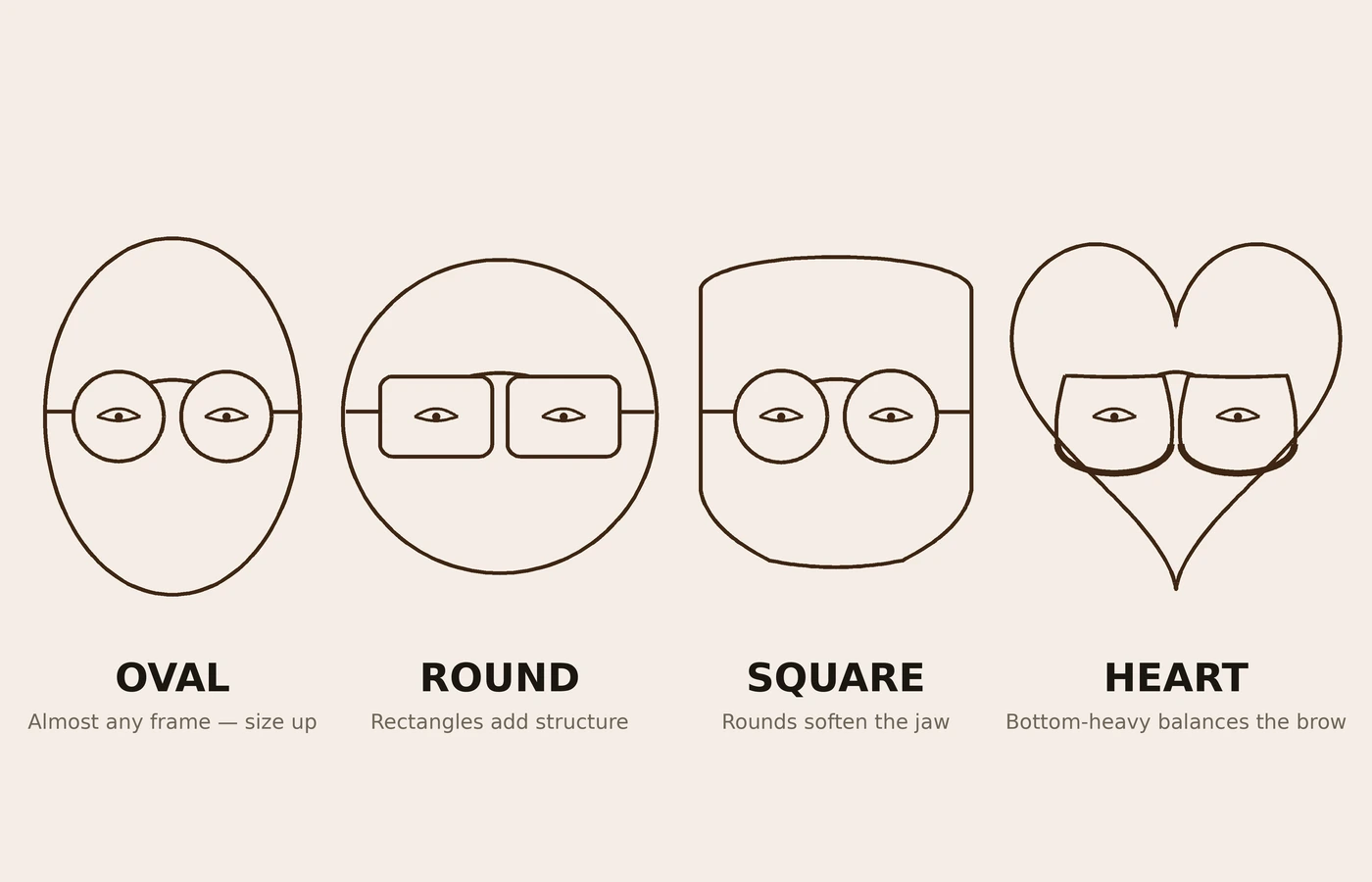
Every "best glasses for face shape" guide on the internet hands you the same four diagrams: round, square, oval, heart. Pick yours, match the opposite, done. It's tidy. It's simple. And it's about half the story.
Face-shape guides are a starting point, not a rulebook. They assume your face is a clean geometry exercise, but real faces are a mix — a round face with a strong brow, a square jaw with soft cheeks, features that pull in two directions at once. Two people with "round faces" can look completely different in the same frame. The charts flatten that into a yes/no, and then you wonder why the recommended glasses feel wrong.
What actually matters: proportions and features. How wide your temples are relative to the frame front. Where your eyebrows sit relative to the top rim. How high your cheekbones are, how your nose bridge carries weight, whether your temples run parallel or taper. A frame that respects those measurements will look good regardless of which shape bucket an algorithm put you in.
That doesn't mean the guides are useless. "Angular frames add structure to soft curves" is a decent heuristic — opposites do create balance. Just don't treat it as a law. The fitting rooms of good independent opticians run on measurements and observation, not on shape charts, and that's the side of the counter this magazine stands on.
Over the next few pages we go shape by shape — round, square, oval, heart — but read them as starting angles, not verdicts. Your face is not a shape. It's a face.
7 Round Faces, Sharp Frames Single page →
Frame Finder
Round Faces, Sharp Frames
Angles add structure to soft curves.
Issue #1 · Published Oct 19, 2026
If your face is round — full cheeks, soft jawline, roughly equal width and length — the classic move is angular frames. Rectangular and square shapes introduce contrast: straight lines and defined corners where your features curve. That contrast reads as structure, and it's why "glasses for round face" searches almost always land on rectangles first.
This season the easy answer is also the fashionable one. The rounded rectangle is 2026's standout shape — straight top edge, softened bottom corners — per the Sept–Oct 2026 trend roundups in our research. It gives you the angular structure a round face wants without going full hard-corner, and the 140–150mm wide fronts of the current sculptural acetate wave mean the frame can match your cheek width instead of disappearing into it.
A round face doesn't need to be 'fixed' — it needs contrast. Straight lines, defined corners, done.
What to avoid: anything that doubles down on roundness without intent. Perfect circles and narrow ovals can make a round face read rounder, especially in small sizes — the frame gets lost and the face looks wider. If you love rounds anyway, go bigger: the "perfect sphere" large-diameter rounds gaining traction this year work because the scale does the structuring.
Two rules of thumb. First, frame width should roughly match your face width at the temples — narrower looks cramped, wider looks like a costume. Second, sit the top rim just under your brows, not hiding them. Eyebrows are the frame's natural partner. Work with them.
8 Square Faces, Soft Edges Single page →
Frame Finder
Square Faces, Soft Edges
Round frames take the edge off a strong jaw.
Issue #1 · Published Oct 19, 2026
Strong jawline, broad forehead, sharp cheekbones — a square face already brings the angles, so frames that echo them can read severe. The counter-move is softness: round, oval, and soft-geometric shapes that contrast the jawline instead of competing with it. That's the standard "glasses for square face" advice, and on this one the charts are mostly right.
Placement matters as much as shape. Sit the frame high enough that your brows show above the top rim — burying a strong brow under a heavy top line makes the whole face look heavier. And watch the width: a square face is often wide at the temples, so frames with narrower fronts will pinch the visual balance and look undersized. You generally want a front that reaches your temple line, not one that stops short of it.
This is a good year for square faces. The softened 70s squares and soft-geometric blends showing up across the Oct 2026 roundups give you structure without the hard corners, and the oversized acetate trend means you'll find rounder, larger options everywhere — including the large-diameter rounds going increasingly unisex this year.
What to avoid: thick, boxy rectangles with sharp corners in dark colors. On a square face that's the visual equivalent of shouting over yourself. If you want rectangular, pick the softened kind — rounded edges, thinner profiles — and let your jawline do the talking on its own.
9 Oval: The Easy Mode Single page →
With an oval face, fit is easy. The real decision is volume: statement frame or invisible one?
Frame Finder
Oval: The Easy Mode
Almost everything works — so don't play it boring.
Issue #1 · Published Oct 19, 2026
Oval faces — balanced proportions, gently curved, forehead slightly wider than the chin — are the fitting world's easy mode. The bone structure is already balanced, so most frame shapes sit well: rectangles, rounds, ovals, cat-eyes, even the avant-garde stuff. If the charts have a "lucky" category, it's this one.
That freedom creates the one real mistake: frames that are too small. An undersized frame on an oval face looks like an afterthought — it shrinks the face visually and makes the features look crowded. When everything fits, scale becomes the thing that separates a good pair from a great one. This is the year to go bigger: the sculptural oversized acetate wave, with 140–150mm fronts, is practically built for oval faces. Cat-eyes with their subtle 15–20° modern upturn, the new cleaner pilot shapes, the oversized rounds — all fair game.
The other thing to watch is proportion between the frame and your features, not the shape category. Keep the top rim under the brows. Keep the width near your temple line. Beyond that, choose by personality: bold acetate if you want the glasses to lead, invisible titanium minimalism (18–22g wire, the Lindberg benchmark) if you want them to disappear.
Oval face, best problem in the book: your constraint isn't fit, it's deciding how loud you want to be.
10 Heart Faces, Balanced Single page →
Frame Finder
Heart Faces, Balanced
Weight at the bottom evens out a wider forehead.
Issue #1 · Published Oct 19, 2026
Heart-shaped faces — wider forehead, narrower chin, sometimes with a pointed jaw — need balance, not contrast for its own sake. The goal is visual weight lower on the face: bottom-heavy frames, rimless or semi-rimless styles, and shapes that widen slightly toward the bottom. Anything that draws the eye downward and softens the forehead-to-chin ratio.
This is where rimless frames earn their reputation. A rimless or semi-rimless pair keeps the upper face visually light while the lenses still define the eyes — and 2026's ultra-light titanium minimalism (18–22g wire frames, Lindberg the benchmark) means rimless is having a genuine moment, not a compromise. Ovals and soft rounds also do the job; both keep the top line gentle.
What to avoid: top-heavy designs. Big bold brow bars, heavy straight top edges, and the oversized shield sunglasses that are all the rage will emphasize exactly the width you're trying to balance. If you love the oversized acetate trend, pick the softer executions — smoked crystal or tone-on-tone finishes read lighter than solid black, and a rounded bottom edge helps.
One more lever: color. This year's deep reds and rich browns — burgundy, mahogany, cognac, dark tortoise — are forgiving on heart faces because warm mid-tones don't draw a hard horizontal line the way black does. Balance is more than shape — it's everything the frame puts on your face.
11 Read Your Size Single page →

Frame Finder
Read Your Size
Three numbers run the whole fitting game.
Issue #1 · Published Oct 19, 2026
Flip any pair of glasses over and look inside the temple arm. You'll find something like 52-18-140 stamped there. That's not a serial number — it's the entire fitting formula, in millimeters. Lens width 52. Bridge width 18. Temple length 140. Every decent frame on earth speaks this language, and once you read it, shopping gets dramatically easier.
Lens width is the horizontal width of one lens. Bridge width is the distance between the lenses where they cross your nose. Temple length is the arm from hinge to tip. Together they describe the frame's footprint on your face. Two frames labeled the same lens width can fit differently because of shape, but two frames with the same three numbers are always in the same neighborhood.
Here's the move: measure your current pair. The pair you like — the one that fits. Read those three numbers off the arm, and now you have your personal spec sheet. Any frame within a couple millimeters on all three numbers is a safe bet; anything more than 4–5mm off in lens or bridge width will feel meaningfully different. Online listings almost always publish these numbers. In-store, they're on the arm. Either way, you now shop by data, not vibes.
This is also the secret weapon of the best glasses buyers we know: they keep their numbers in their phone. Next time a site says "virtual try-on," you'll already know your size before the camera opens.
52-18-140 isn't a serial number. It's your face's measurements, in disguise.
12 The Bridge Report Single page →
Frame Finder
The Bridge Report
The smallest part carries all the weight.
Issue #1 · Published Oct 19, 2026
The bridge is the least glamorous part of a frame and the most important. It's the load-bearing wall: on a padless frame, the bridge carries the entire weight of the glasses on your nose. Get it wrong and everything downstream fails — slipping, pinching, red marks, the works. Get it right and the rest of the fit almost takes care of itself.
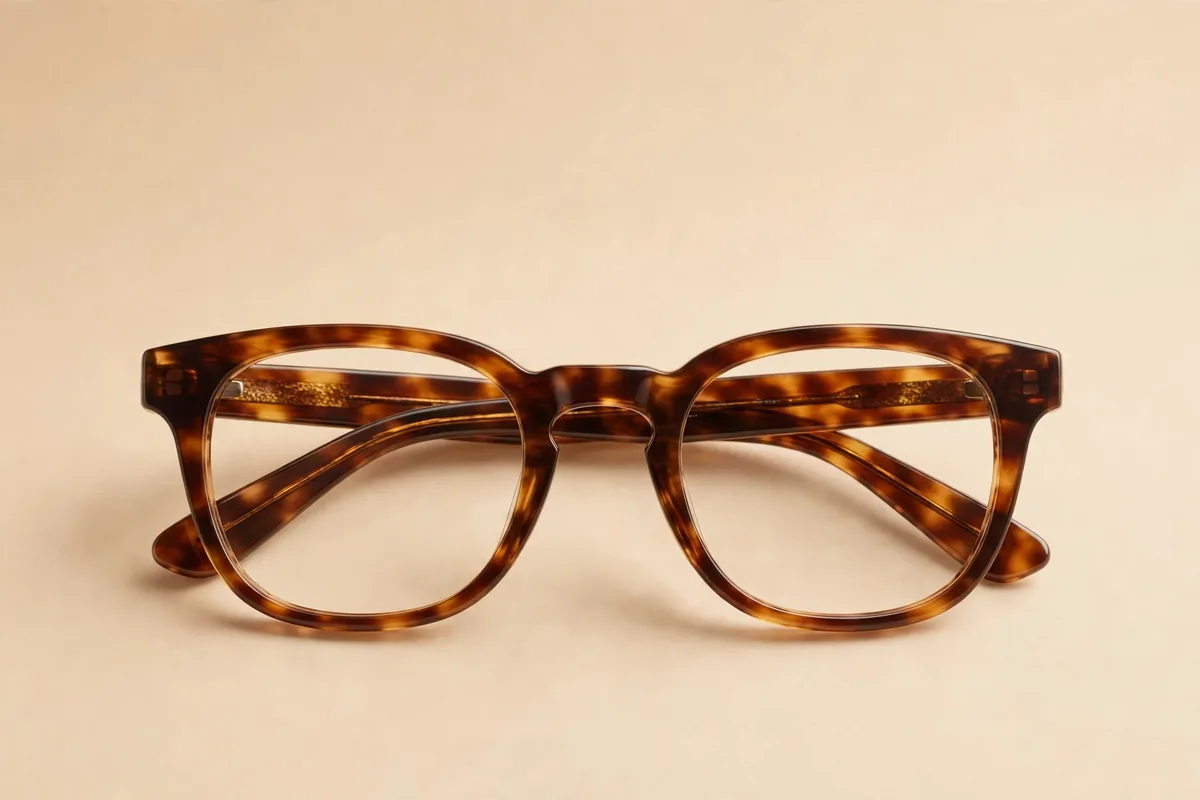
Three main designs. The keyhole bridge — the classic shape with a little notch — distributes weight across the sides of the nose and suits narrower, more defined noses. The saddle bridge spreads a wider, flatter contact area and suits broader noses and lower bridges; it's the workhorse of comfortable acetate frames. Adjustable nose pads — the little silicone or titanium pads on metal frames — can be bent and angled by an optician to fit almost any nose, which is why wire and rimless frames depend on them.
Low-bridge fit deserves its own mention. If your nose bridge sits lower or flatter, standard bridges will slide and the lenses will sit on your cheeks. Look for frames explicitly designed for low bridges — wider saddle shapes, adjusted pad angles, higher-set bridges — rather than fighting a standard frame into submission. More brands are cutting these options now; ask for them by name.
Rule of thumb: the bridge should rest on your nose, not grip it. If you take the glasses off and see angry red marks that fade slowly, the bridge is too narrow. If they slide the moment you look down, it's too wide.
Everything about fit starts at the bridge. It's the foundation — build up from there.
13 Temple Talk Single page →

Frame Finder
Temple Talk
The arms do the holding; the bridge does the balancing.
Issue #1 · Published Oct 19, 2026
Temple arms are the unsung half of the fit. The bridge keeps the front from sliding down; the temples keep the whole thing from sliding forward. They run from the hinge, along the side of your head, and bend down behind the ear. That bend — the drop — is where the grip happens. Too short and the glasses perch on your nose and slide. Too long and the arms poke past your ears and the frame feels loose and sloppy.
The stamped number (the 140 in 52-18-140) measures the full arm length, but the part that matters is where the bend lands relative to your ear. On a well-fitted frame, the bend starts right at the top of your ear and the tip follows the curve of your skull without digging in. If the bend starts before your ear, the arms are too short. If it starts an inch behind, too long.
Skull grip is the other half. The arms should touch the sides of your head lightly and evenly — enough contact to stabilize, never enough to press. Pinching at the temples is the classic sign of arms that are too short or a front that's too narrow; headaches that start an hour into wear almost always trace back to here.
Good news: temple fit is the most adjustable part of the frame. A decent optician can heat and rebend acetate arms or adjust metal ones in minutes, often free. If everything else about a frame is right but the temples are off, that's a fix, not a dealbreaker.
Headaches that start an hour in? That's the temples talking. Listen to them.
14 Pads or No Pads Single page →
Frame Finder
Pads or No Pads
Two philosophies of sitting on your nose.
Issue #1 · Published Oct 19, 2026
Every frame picks a side: adjustable nose pads, or a molded bridge with no pads at all. Neither is better. They solve different problems, and knowing which problem you have is the whole decision.
Nose pads — the small silicone, titanium, or acetate pads mounted on little arms — win on adjustability. An optician can angle them, spread them, or swap them to fit narrow noses, asymmetric noses, low bridges, and everything in between. They're standard on metal and rimless frames, and they're why those frames can fit faces that a rigid acetate bridge never could. The tradeoff: they touch down in two small spots, so pressure concentrates there. They also need occasional maintenance — pads wear, yellow, and harden over time, and replacements are cheap and easy.
Molded acetate bridges — the solid, sculpted bridge on plastic frames — win on weight distribution. The contact area is broad and the weight spreads out, which many people find more comfortable for all-day wear. No pads to replace, no metal arms to catch hair. The tradeoff: what you see is what you get. The bridge shape is fixed, so if it doesn't match your nose, there's no adjusting it — only choosing a different frame.
Quick decision guide: narrow or low nose bridge, asymmetric nose, or you need precision? Pads. Broad nose, comfort priority, and the bridge shape already matches you? Molded. And if you wear pads and they leave marks — that's not a pads problem, it's an adjustment problem. Get them reset.
15 Clear the Cheeks Single page →
Smile in the mirror before you buy. Your cheeks will tell you the truth the numbers can't.
Frame Finder
Clear the Cheeks
Two clearances decide all-day comfort.
Issue #1 · Published Oct 19, 2026
Comfort isn't one thing. It's two small gaps — and when either one fails, the glasses become unwearable by mid-afternoon.
Clearance one: cheeks. Put the frames on and smile — a real smile, not a polite one. Do your cheeks push the lenses up or out? Do the bottom rims sit on your cheekbones? Then the lens depth is wrong for your face, or the bridge is sitting too low. This is the fit failure nobody checks in the store mirror, because nobody smiles in the store mirror. Cheek contact means constant micro-adjustments all day, smudged lenses from below, and frames that migrate with every expression. The fix is shallower lenses, a higher bridge position, or pads adjusted to lift the front.
Clearance two: eyelashes. Blink. Do your lashes brush the back of the lenses? A light occasional touch is common with strong prescriptions and long lashes, but constant contact means the lenses sit too close — the vertex distance is too short. Lash contact smears the lenses from behind, irritates the eyes, and gets worse with every blink. The fix: more vertex distance (pads adjusted outward, or a frame with more standoff), or flatter lens curvature.
Both clearances are about depth — the frame's relationship to the face in three dimensions, not just width and height. And both are why "try it on" will always beat "measure it online." Numbers describe the frame. Clearances describe the fit.
16 The 3-second Rule Single page →
Frame Finder
The 3-second Rule
Try-on tricks that beat the store mirror.
Issue #1 · Published Oct 19, 2026
The store mirror lies — or at least, it only tells you how glasses look from twelve inches away, head-on, under fluorescent light. Nobody in your life sees you that way. So run the real tests.
One: the arm's-length mirror. Hold the mirror out or step back. People see you from conversation distance, not from the shelf. Frames that look bold up close often read perfectly normal at six feet, and tiny frames that looked "subtle" in the close mirror disappear entirely. Judge the glasses the way the world will see them.
Two: take a photo. Front, then profile. The profile shot is the one everyone skips and the one that matters — it shows whether the temples sit level, whether the front tilts, whether the arms bow out past your head. A photo also freezes your expression, so you can check the cheek clearance from the last page without holding a smile.
Three: the daylight test. Step outside or to a window. Store lighting is designed to sell; daylight is designed to be honest. Colors shift — that "subtle tortoise" can go full amber in the sun — and you'll see the real contrast between the frame and your face.
Bonus round: talk, laugh, look down at your phone, shake your head once. Glasses live on a moving face. If they need adjusting after thirty seconds of real life, they'll need adjusting all day.
17 Screen vs Store Single page →
Frame Finder
Screen vs Store
Virtual try-on vs. a human with warm hands.
Issue #1 · Published Oct 19, 2026
Buying glasses has split into two worlds, and both are getting better fast. Here's the honest scorecard.
The screen's case: virtual try-on is genuinely useful for narrowing shape and style — seeing a rounded rectangle on your actual face beats imagining it. And digital PD measurement via photo has improved a lot — good enough for most single-vision orders, though a professional measurement is still the most accurate way to place a lens (Cleveland Clinic's guidance). Online prices are lower, the selection is bigger, and you can try on forty frames in your pajamas. The online channel is the fastest-growing in eyewear for a reason.
The screen's limits: a photo can't feel pressure. It can't tell you the bridge is a millimeter too narrow or that your lashes will touch the lenses. Virtual try-on shows the front view only — no profile, no cheek clearance, no temple grip. And PD is only one measurement; segment heights, pantoscopic tilt, and wrap angles all need a human or a very good system.
The store's case: a skilled optician adjusts the fit in real time — heating acetate, bending temples, angling pads — and reads your face the way no algorithm does. Complex prescriptions, progressives, and tricky fits belong in-store, full stop.
The honest play: use the screen to find your shape, use the store to confirm your fit. They're not rivals. They're two halves of one purchase.
Sources: Cleveland Clinic, Pupillary Distance (PD): What It Is & How to Measure; ZEISS, A checklist for buying new eyeglasses.
18 Fix Your Fit Single page →
Fit problems are mechanical. Diagnose the cause, don't just endure the symptom.
Frame Finder
Fix Your Fit
Every common problem has a cause and a fix.
Issue #1 · Published Oct 19, 2026
Glasses problems are mechanical, which means they're diagnosable. Here's the field guide.
Slipping down the nose. Cause: bridge too wide, pads angled wrong, or temples too loose to anchor the front. Fix: narrow the bridge fit (pads angled inward, or a different bridge), tighten the temple grip, or both. If it only happens when you look down, the temples are the culprit.
Pinching temples. Cause: front too narrow or temple arms too short, squeezing the sides of the head. Fix: an optician can widen acetate fronts with heat or adjust metal arms outward — often free, takes minutes. Headaches that build through the day almost always start here. Don't tough it out; get it adjusted.
Crooked sit. Cause: one temple arm bent differently than the other, or an asymmetric bridge — most faces are slightly asymmetric, so this is normal. Fix: stand in front of a mirror, close one eye, and check whether the front is level. An optician evens the arms in one visit. Never bend them yourself; you'll snap a hinge or void a warranty.
Lashes touching lenses. Cause: too little vertex distance — the lenses sit too close to the eyes. Fix: pads adjusted to push the front out, or a frame with more standoff. Common with long lashes and strong prescriptions.
One boundary: fit is mechanical, but your eyes aren't. If glasses cause persistent pain, dizziness, or vision problems, that's an optician or eye doctor conversation — not a fitting tweak.
19 Small Faces, Big World Single page →
Frame Finder
Small Faces, Big World
Kids' frames are engineered, not just shrunk.
Issue #1 · Published Oct 19, 2026
A child's frame is not an adult frame made smaller. It's a different engineering problem — and the differences matter more than most parents realize.
First, the fit targets move. Kids' noses are lower and flatter, so children's frames use adjusted bridge designs and softer pad configurations to sit correctly instead of sliding. Their heads are still growing, so temple arms need the right length now with room to adjust later — too long and the glasses fall off during play; too short and they pinch a growing skull. Flexible hinges (spring hinges that bend outward without breaking) aren't a luxury on kids' frames; they're survival equipment.
Second, durability is a design spec, not a hope. Kids' frames get dropped, sat on, twisted, and used as toys. Flexible materials, reinforced hinges, and scratch-resistant thinking go into frames that cost more to engineer than their size suggests. A strap or cable temple option — arms that hook behind the ears — can be the difference between glasses that stay on and glasses that live in a backpack.
Third, and this is the bridge to our Lens Lab section: kids are the fastest-growing segment in eyewear, driven by rising myopia. Myopia-control lenses — Essilor's Stellest, Hoya's MiYOSMART, ZEISS's MyoActive — are a genuine breakthrough for slowing progression in children, and they only work if the child actually wears them. Which brings us right back to fit. The best lens in the world does nothing in a drawer.
20 The Fit Cheat Sheet Single page →
Frame Finder
The Fit Cheat Sheet
Everything in Frame Finder, on one page.
Issue #1 · Published Oct 19, 2026
Face shapes are starting points, not laws. Angular frames add structure to round faces; round frames soften square jaws; oval faces can wear nearly anything (but size up — small frames are the classic mistake); heart faces want weight lower on the face, with rimless and bottom-heavy styles balancing a wider forehead. Proportions beat diagrams.
Read your size. The three numbers inside the temple arm — lens width, bridge width, temple length, in millimeters (e.g. 52-18-140) — are your personal spec sheet. Measure the pair you love, keep the numbers in your phone, shop by data.
The bridge carries the weight. Keyhole for narrower noses, saddle for broader ones, adjustable pads for precision and low bridges. Red marks mean too narrow; sliding means too wide.
Temples do the holding. The bend should start at the top of your ear. Light, even skull contact — never pressure. Hour-in headaches trace back here, and an optician can rebend arms in minutes.
Pads or molded? Pads for adjustability and tricky noses; molded acetate for broad, comfortable weight distribution. Marks from pads mean bad adjustment, not bad pads.
Check both clearances. Smile — cheeks shouldn't push the lenses. Blink — lashes shouldn't brush them. Numbers describe the frame; clearances describe the fit.
Try on like you mean it. Mirror at arm's length, photo front and profile, daylight test, then talk, laugh, and look down. Glasses live on a moving face.
Screen finds shape, store confirms fit. Virtual try-on narrows style; digital PD via photo is workable for simple orders, but a professional measurement is the most accurate. Complex fits and progressives belong in-store.
Kids need engineered frames, not shrunken ones: adjusted bridges, flexible hinges, strap options — because the best myopia-control lens only works when it's worn.
Sources: Cleveland Clinic, Pupillary Distance (PD): What It Is & How to Measure; ZEISS, A checklist for buying new eyeglasses.