
Issue #1 — The Debut · The Craft
The Craft: the whole section
How great frames are made, from Japanese workshops to the bench — every Craft story from the debut issue, in order, on one page. Prefer it page by page? Start at page 81, or browse the The Craft hub.
81 WHY HANDMADE WINS Single page →
 The Craft
WHY HANDMADE WINS
Your hands know what your eyes can't.
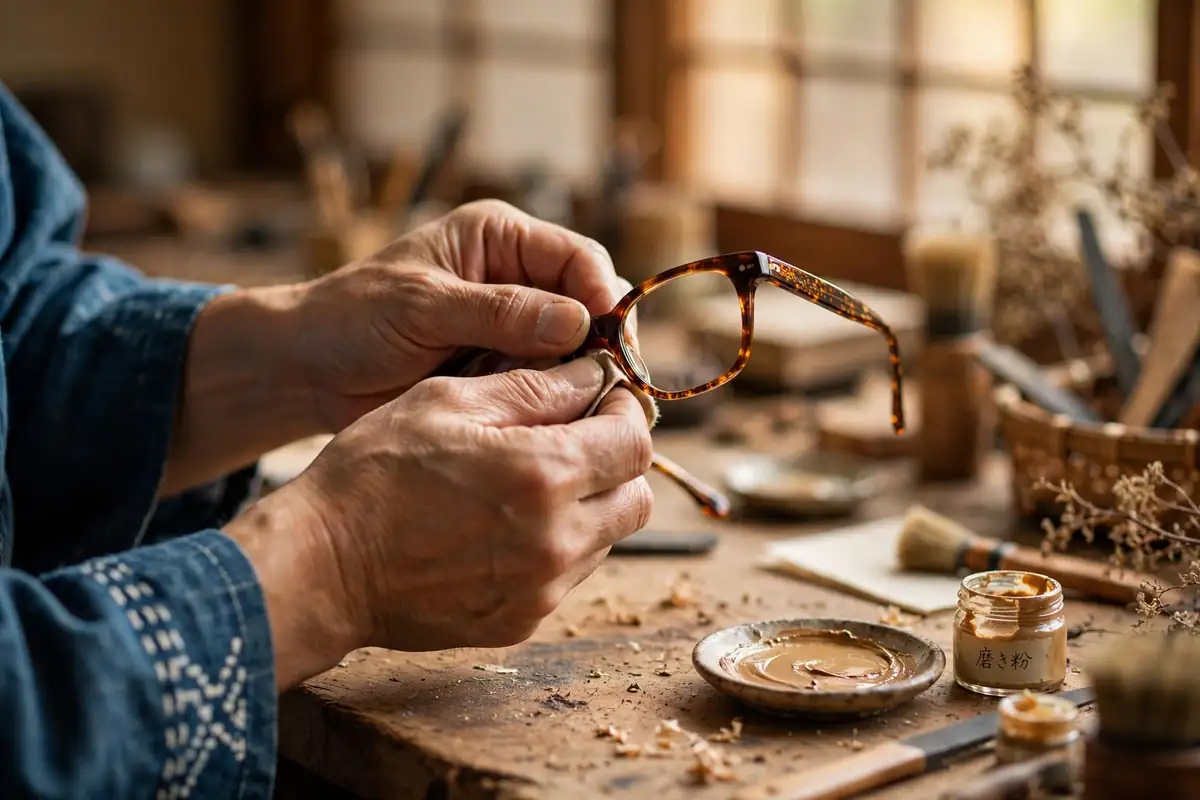
Pick up two frames. Same shape. Same color family. One feels alive in your hands; the other feels printed. Your fingers catch it before your eyes do: edges that give instead of bite, weight that settles instead of presses, a shine that runs deep instead of sitting on top. The difference is real, and it has one ingredient no machine can fake — attention.
This isn't romance. It's decisions. A machine optimizes for a single thing: speed. A handmade frame is hundreds of judgment calls — cut deeper here, polish longer there, stop before you go too far — made by people you'll never meet but who built for your face anyway. That's not a marketing story. That's what happens when human hands touch a frame instead of a conveyor belt, and it's why the best handmade frames feel less like products and more like they were finished with you in mind.
This section goes inside that difference. We start in Sabae, Fukui, the Japanese town producing roughly 90% of the country's frames — eyewear has been made there since 1905 — a history the Sabae eyewear association documents in detail. You'll learn how acetate and titanium frames are actually built, why the humblest part of a frame — the hinge — decides its lifespan, which indie labels are pushing the craft forward, and what a 71-hour frame feels like in your hands.
Our promise: after these pages, you'll never buy glasses the same way again. Not because we'll tell you what to buy. Because you'll finally know what you're looking at — and once you know, the cheap tricks stop working on you.
82 SABAE, FUKUI Single page →
The Craft
SABAE, FUKUI
The small town making most of Japan's frames.
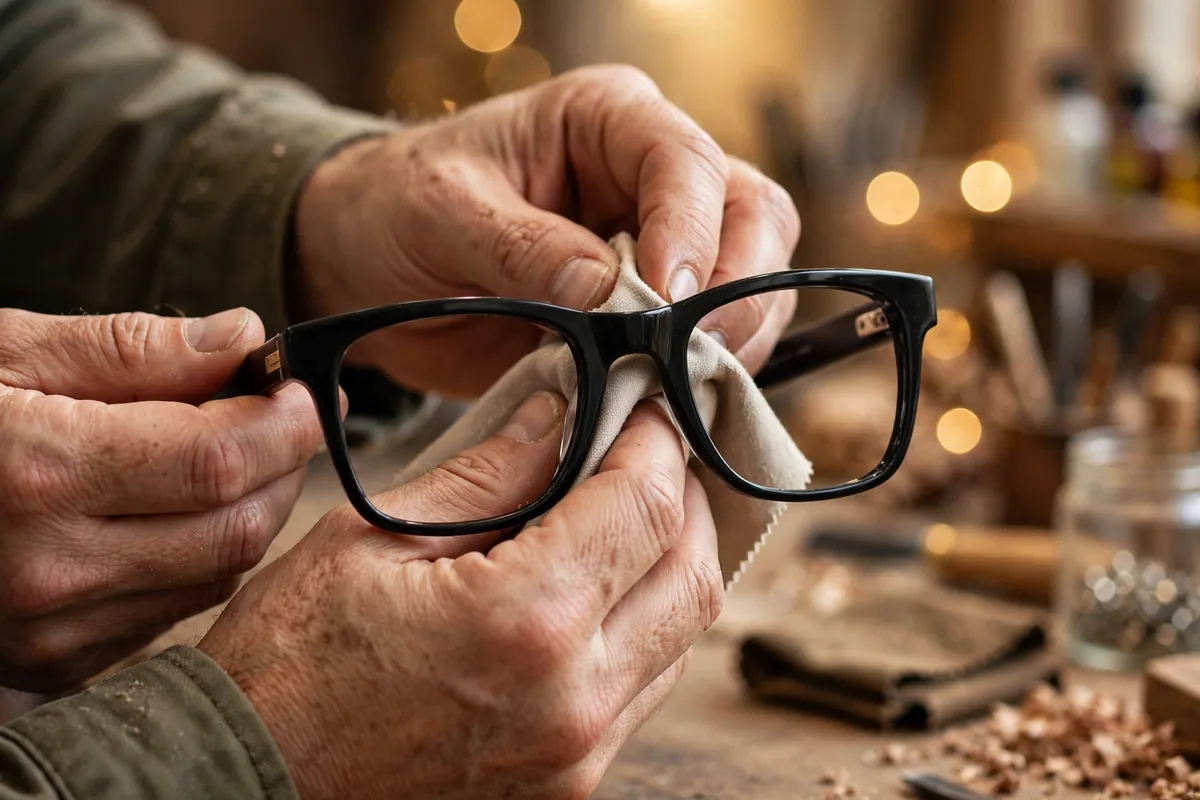
In the mountains of Fukui prefecture sits Sabae, a quiet Japanese city with an outsized job: roughly 90% of Japan's eyewear frames are made here, and the town has been making them since 1905, when the craft arrived from Osaka — the founding story Masunaga, one of the region's original makers, still tells. Walk its streets and you'll find the whole supply chain within a short drive — acetate cutters, titanium specialists, hinge workshops, polishing ateliers — a cluster of craft so dense that a frame can pass through a dozen expert hands without leaving town.
This density is the secret. In Sabae, the person who cuts your frame probably eats lunch with the person who polishes it. Knowledge compounds. Techniques that took a century to refine get passed down, workshop to workshop, instead of being locked inside a single factory. The result is an ecosystem where quality is the default setting — and where Japanese eyewear craftsmanship earned its reputation one frame at a time.
It's also a subculture. Connoisseurs know Sabae the way watch people know Geneva. Yet English-language coverage of its artisans is thin, mostly confined to retailers' blogs — a gap this magazine exists to close. The workshops here aren't chasing trends; they're refining a century-old discipline while a new generation of indie labels pushes it forward.
So when you hold a frame that feels inexplicably right — balanced, smooth, finished like it was meant for you — check the temple label first. There's a good chance it started life in Sabae, in a town that never learned to cut corners — and never needed to.
83 ACETATE VS TITANIUM Single page →
The Craft
ACETATE VS TITANIUM
The only frame-material comparison that matters.
The acetate vs titanium frames debate comes down to one question: do you want your glasses to speak, or to disappear? Acetate speaks. It's the material behind 2026's sculptural oversized moment — wide fronts, thick temples, deep color. Titanium disappears: featherweight wire frames and rimless designs you forget you're wearing.
On weight, titanium wins outright. Its strength-to-weight ratio is the reason premium minimal frames can be absurdly thin yet structurally sound, and it's naturally hypoallergenic — a real advantage for sensitive skin. Acetate has presence instead: it sits with intention, warms to your touch, and holds color and lamination like nothing else in eyewear. One vanishes; the other performs.
Durability is where it gets honest. Titanium resists corrosion and bends back where acetate chips or snaps — but titanium is brutally hard to work, which is exactly why it costs more. Acetate, meanwhile, is repairable in ways metal isn't: it can be reheated and reshaped by any good optician, re-polished, and restored. A scratch in titanium is a story you keep; a scratch in acetate can be buffed away. Neither material is fragile. They're fragile in different places.
So who suits whom? Choose acetate if you want expression — color, texture, silhouette, the frame as outfit. Choose titanium if you want minimalism — featherweight comfort, clean geometry, nothing between you and the world. Neither is the "better" material. They're opposite philosophies, and the right one is the one that matches how you want to show up. Start there, and the choice makes itself — every time.
84 FROM COTTON TO POLISH Single page →
The Craft
FROM COTTON TO POLISH
How an acetate frame earns its shine.
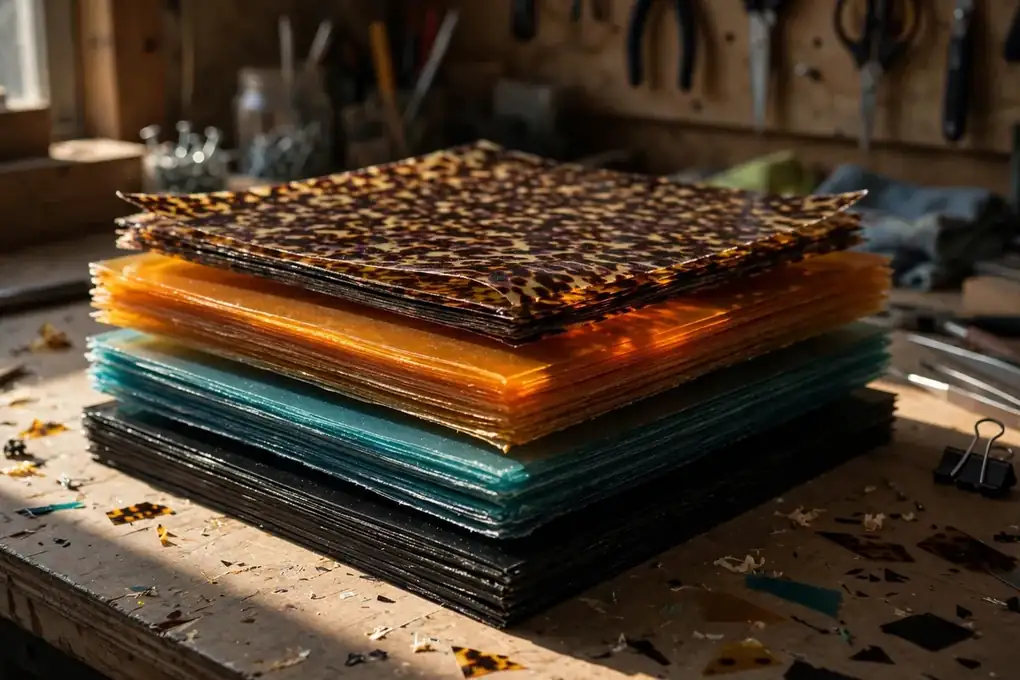
Acetate starts as a plant. Not a metaphor — the stuff is cellulose acetate, derived from cotton fibers and wood pulp, which makes it the rare plastic with agricultural roots. Sheets of it arrive at the workshop in colors that look dull and flat. Everything beautiful happens after.
First comes the cut: fronts and temples are sliced from sheets, rough-shaped by machine. Then the long road begins. Frames get tumbled — rattled in barrels with polishing media that slowly knocks down the rough edges, a process that can't be rushed without leaving scars. After tumbling, craftspeople take over: edges are beveled by hand, surfaces refined, and the polishing begins in stages, from coarse compounds to the finest ones. The shine on a great acetate frame isn't applied. It's excavated, layer by layer, by people who know exactly when to stop.
This is why the 2026 shift toward thinner sheets and richer laminations matters. Thinner acetate is less forgiving — every flaw shows — so it demands better cutting and better polishing. Richer laminations mean more layers of color fused into a single sheet, so the pattern runs through the frame instead of sitting on the surface. Cheap acetate is printed. Good acetate is geology: strata of color you can fall into.
Next time you hold a frame up to the light, look into the color. If you can see depth — layers, movement, something going on beneath the surface — you're holding the long road. That's not decoration. That's the plant, the barrel, and the hands, all of it still visible if you know where to look.
The shine on a great acetate frame isn't applied. It's excavated.
85 THE METAL THAT REMEMBERS Single page →
Titanium doesn't forgive shortcuts. That's exactly why the good ones cost what they cost.
The Craft
THE METAL THAT REMEMBERS
Titanium: featherweight, hypoallergenic, unforgiving to make.
Titanium is the hardest-working material in eyewear and the least forgiving. Its strength-to-weight ratio lets premium minimal frames be impossibly thin — wire frames as light as 18 to 22 grams, per trend roundups from Sept–Oct 2026, essentially nothing on your face — while staying structurally sound. It's naturally hypoallergenic, so it plays well with sensitive skin where nickel-bearing alloys can irritate. Featherweight. Tough. Kind to faces. That's the pitch, and it's true.
The catch is the making. Titanium fights back at every step. It work-hardens under the cutting tool, meaning it gets tougher the more you touch it. Welding it requires inert gas and precision equipment, because the metal reacts with oxygen at high temperatures and weakens if the weld isn't shielded. There are no shortcuts here — only skill, slow feeds, and craftspeople who understand exactly what the material wants to do. Patience isn't optional with titanium. It's the whole technique.
That's why it costs more, and why the price is honest. A titanium frame that lasts a decade isn't expensive per year; it's just priced for the difficulty of its birth. You pay for the difficulty once and enjoy the result for a decade. The material remembers everything — every shortcut shows up later as a fracture, a misalignment, a joint that gives out. The workshops that master it treat titanium like an opponent worthy of respect.
Hold a well-made titanium frame. It weighs nothing and feels like everything. That's not a contradiction. That's the metal, and it's the material for people who want their glasses to vanish.
86 THE HUMBLE HINGE Single page →
The Craft
THE HUMBLE HINGE
The tiniest part decides how long your frames live.
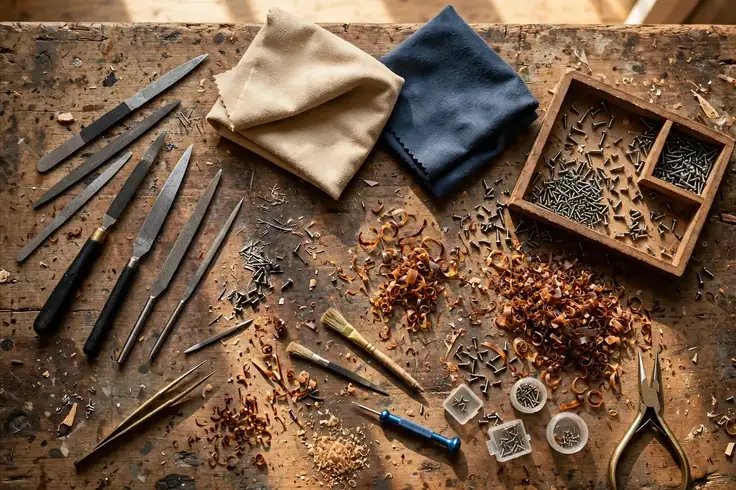
Every frame is a tiny machine, and the hinge is its engine. Temples fold and unfold thousands of times over a frame's life, and the hinge absorbs every bit of it. This is where cheap frames go to die — not with a dramatic snap, but with a slow loosening, a temple that won't stay put, a screw that keeps backing out until one day it doesn't. A hinge that dies young takes the whole frame with it: the lenses, the fit, the look you loved. All of it, over the smallest part in the build.
The industry standard is the five-barrel hinge: interlocking knuckles pinned with a screw, simple and serviceable. Spring hinges add flex, letting temples bend outward without stressing the joint — a comfort upgrade that's become a selling point in its own right. And then there's the enthusiast tier: improved hinge engineering is now marketed as a feature, not a footnote, and labels like Tanabiku build proprietary seven-layer hinges, per our October 2026 research, treating the joint as a signature rather than a commodity.
Here's the test nobody runs in the store: open and close the temples slowly. Do they move with resistance, or do they flop? A good hinge has a satisfying, deliberate action — friction you can feel. That friction is the difference between a frame that survives five years and one that survives fifteen.
Respect the hinge. Next time you try on frames, work the temples before you check the mirror. The mirror shows you the style. The hinge shows you the future.
Every frame is a tiny machine. The hinge is its engine.
87 THE 71-HOUR SHINE Single page →
The Craft
THE 71-HOUR SHINE
Matsuda and the economics of patience.
Matsuda makes frames the slow way. Up to 250 steps. Thirteen craftsmen. Around 71 hours of handwork in a single frame, by Matsuda's own count. Hand-engraving is done by one of the last master engravers in Fukui — not a department, a person. When you wear a Matsuda, you're wearing three days of someone's working life, and you can feel it the second you pick them up. Three days. One frame. Zero shortcuts.
The brand calls its philosophy "New Nostalgia": designs rooted in the past, built for the future, with film heritage to back it up — the Matsuda 2809 was worn by Linda Hamilton (Sarah Connor) in Terminator 2, and the M3023 by Robert Downey Jr. in Iron Man. But the philosophy only works because the execution is real. Engraving by hand means every line carries the tiny irregularities that machines can't replicate and humans can't help but love. Two hundred and fifty steps means 250 moments where a craftsperson decided this frame was worth doing properly.
This is what hand-finishing actually means. Not "touched by a human at some point" — that's true of almost everything. It means the human was the instrument: the engraving tool, the polishing judgment, the eye that said "one more pass" when a machine would have stopped an hour ago. It's slower, costlier, and completely irreplaceable.
Patience has a price. It also has a feel. Run your thumb along a hand-engraved bridge and tell us machines don't have souls. That's the 71-hour shine — not a finish, but a record of every hour someone refused to rush.
Corrected Oct 19, 2026 — see Standards & Corrections.
88 INDIE BRANDS I Single page →
Independence is a manufacturing choice, not a marketing one.
The Craft
INDIE BRANDS I
Japan's independents, part one: 999.9, ayame, Kaneko.
In the shadow of Sabae's giants, a generation of Japanese indie labels is rewriting what domestic eyewear can be. These aren't factories with a logo — they're small, design-led operations building in limited runs, obsessing over fit and finish, and earning followings that punch far above their size.
999.9 — known as Fournines — and ayame are two of the names you'll hear first in any serious conversation about Japanese independent eyewear. And Kaneko Optical keeps its production in-house and has become a genuine celebrity favorite, per our October 2026 research — proof that keeping the work close to home still turns heads.
What unites them isn't a single look. It's a posture: independence as a manufacturing choice, not just a marketing one. In-house production means the designer can walk to the workshop and change a bevel. Small scale means a frame can be strange, specific, perfect for somebody instead of acceptable to everybody.
Why should you care? Because this is where the interesting frames live. The big houses optimize for everyone; the indies optimize for someone — a narrower bridge here, a bolder front there, a fit quirk solved instead of smoothed over. When a label makes hundreds of pieces instead of hundreds of thousands, it can afford to be specific. And specificity is what makes a frame feel like it was made for you.
This is the connoisseur layer of Japanese eyewear craftsmanship — the labels the insiders whisper about, and the reason the country's indie scene keeps gaining ground. Consider this your introduction.
89 INDIE BRANDS II Single page →
The Craft
INDIE BRANDS II
DAIZO, Dillinger, Taxxon: the rule-breakers.
If the last page was about refinement, this one is about nerve. DAIZO works in brutalist acetates — chunky, architectural frames that treat plastic like concrete: honest, heavy, unapologetic. These are frames for people who want their eyewear to have opinions. Dillinger brings its own edge to the Japanese indie scene, building frames with a swagger that stands apart from the quiet-luxury crowd.
And then there's Taxxon, which might be the most interesting experiment in Japanese eyewear right now. The label produces in 300-piece batches and applies kaizen — continuous improvement — to every run, per our October 2026 research. The result: no two batches are identical. Buy a Taxxon frame this season and the next batch will be slightly better, slightly different. Your pair is a snapshot of a workshop getting sharper in real time.
This is craft as a living process, not a frozen tradition. The rule-breakers aren't rejecting Sabae's century of discipline — they're building on it, then asking what it can do next. Brutalist acetate. Rolling revisions. Frames that evolve like software but feel like sculpture.
That's the deeper story. Japanese eyewear craftsmanship didn't get famous by standing still — Sabae has been iterating since 1905, and these labels are the latest proof. Tradition is the foundation; restlessness is the engine. The frames that result don't just look different. They feel like the future arriving early, in acetate.
The establishment makes the standard. The indies make the future. One keeps the craft alive. The other keeps it interesting. Watch both — and wear the interesting one.
90 WHAT "MADE IN" MEANS Single page →
The Craft
WHAT "MADE IN" MEANS
Provenance is a quality marker — not a guarantee.
Handcrafted provenance — Japan, Italy, France — is one of the strongest quality signals in eyewear — it's how the industry itself talks about excellence. But the label on the temple tells you less than you think. "Made in" names the last significant stop on a frame's journey, not the whole trip. Design, cutting, assembly, and finishing can happen in different countries, by different hands, before a frame earns its stamp.
That's not a scandal. It's how global manufacturing works. The question is never "which country?" — it's "who stands behind the work?" A frame with named workshops, in-house production, and accountable craftspeople beats a prestigious label with an anonymous supply chain every time. Provenance is a starting point for trust, not the whole of it.
So read labels like an insider. Look for specifics over slogans: the town, not just the country. The workshop, not just the brand. Ask who cut the acetate and who polished it — and notice whether the brand can answer. The good ones love that question. The great ones answer it before you ask.
None of this diminishes what Japan, Italy, and France represent. Those markers earned their weight over decades — Sabae's century of frames, Italy's acetate artistry, France's design heritage. They mean something because the workshops behind them do. Just remember: the marker points to the craft. The craft is the point.
"Made in Japan" should mean something. Your job — as a member of this club — is to make sure it does.
91 BIO-ACETATE AND BEYOND Single page →
The greenest frame is the one you keep for twenty years.
The Craft
BIO-ACETATE AND BEYOND
The material future of eyewear.
Sustainable eyewear is having its moment — and this time the materials might be ready. Bio-acetate is rising fast: Etnia Barcelona, Prada's Re-Nylon program, and Lacoste's eco-frames are all pushing plant-based and recycled inputs into the mainstream, per our October 2026 research. On the craft end, Tanabiku has developed a proprietary 10mm bio-acetate — proof that the eco story and the luxury story are converging.
The market is listening. Sustainability has become a luxury signal — not a compromise, but a feature. The 2026 move toward thinner acetate sheets and richer laminations pairs naturally with it: less material, more depth, nothing wasted.
The shift is already visible on the workbench. Workshops are rethinking offcuts, brands are auditing supply chains, and the conversation has moved past greenwashing into genuine material science — bio-acetate sheets that polish like the old stuff, laminations with nothing to hide. The future won't look different: same shine, smaller footprint.
But here's the honest take. The greenest frame isn't the one with the best marketing — it's the one you keep for twenty years. Bio-acetate matters. Recycled nylon matters. What matters more is a frame built well enough that you never want to replace it. Materials are the future of eyewear, but longevity is the whole point.
Buy the eco frame. Then wear it until it becomes vintage — sustainability strategy, one sentence long.
92 THE REPAIR SHOP Single page →
The Craft
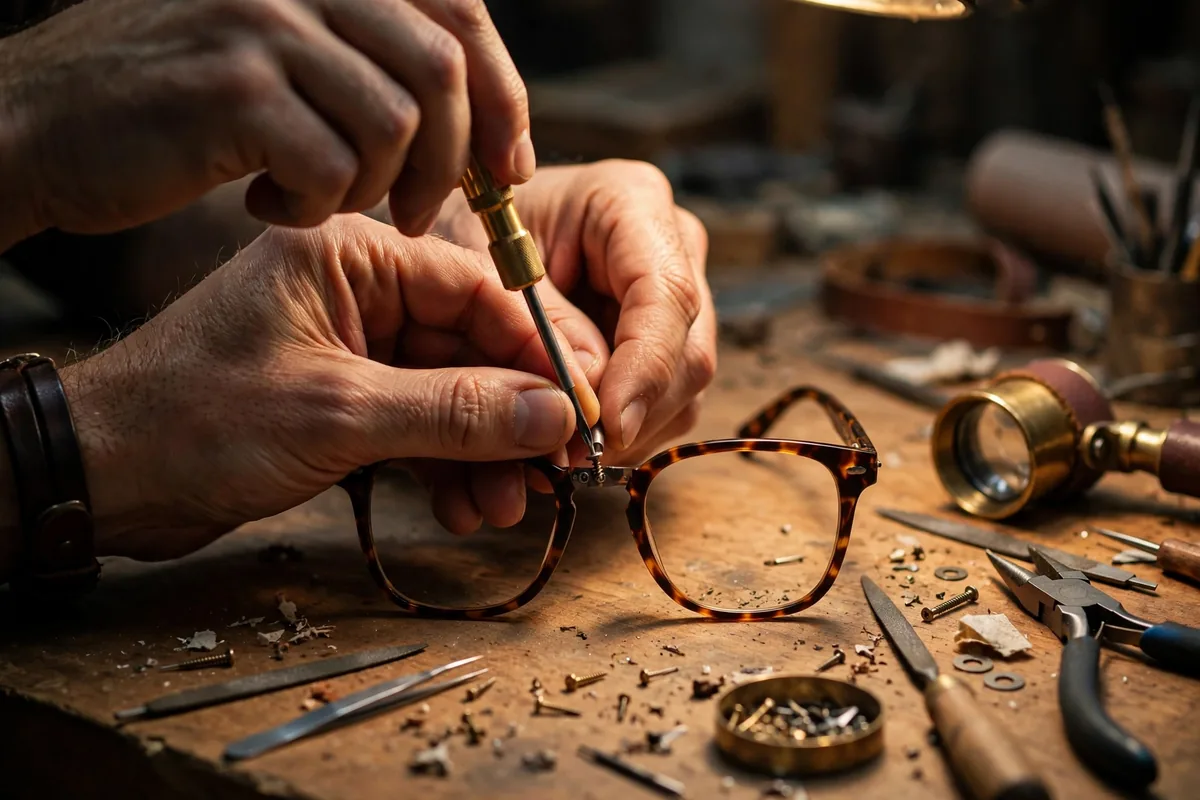
THE REPAIR SHOP
Great frames don't die. They get repaired.
Somewhere in your drawer is a pair of glasses you loved and abandoned — a scratched lens, a wobbly temple, a hinge that gave up. Here's the thing nobody tells you: almost all of that is fixable. Great frames don't die. They get repaired.
Reglazing is the big one. Your frames are fine; your prescription changed. A good optician pops in new lenses and your favorite frames are back in the game — no reason to retire a frame you love just because your eyes moved on. Re-templing handles the snapped arm. Hinge replacement, re-soldering, re-polishing — a skilled repair bench can bring a battered frame back to showroom condition, acetate buffed to a shine you forgot it had.
This is the sustainability story nobody markets, because you can't sell a new frame with it. But it's the most honest one: a well-made frame is a decades-long relationship, not a purchase. The workshops of Sabae build frames to be serviced, not replaced — standard screws, rebuildable hinges, materials that take a polish.
Start with the hinge — it's the usual suspect, and a good bench can re-pin or replace one in minutes. Then the lenses. Then the polish. Each fix costs a fraction of a new frame and keeps a story on your face instead of in a drawer. Repair isn't settling. It's the most connoisseur move in eyewear.
So before you buy new, visit a repair shop. The best frame in your collection might be the one you already own. It just needs a second act.
The best frame in your drawer might be the one you already own.
93 BUY ONCE, BUY WELL Single page →
The Craft
BUY ONCE, BUY WELL
The case for fewer, better frames.
Here's the whole craft section in one sentence: buy fewer frames, and make every one of them count. The industry wants you cycling through pairs like fast fashion. The workshops of Sabae — where roughly 90% of Japan's frames are made, a tradition running since 1905 — want the opposite: one frame, built right, worn for years.
Do the math your own way. A frame that survives a decade costs less per year than three disposable pairs, and it looks better every single one of those years. Acetate deepens. Titanium shrugs off abuse. A seven-layer hinge, like the ones Tanabiku builds, keeps folding long after cheap joints give out. A frame with 71 hours of handwork in it, like a Matsuda, doesn't go out of style — it was never in style to begin with. It was built.
This is also the quietest form of sustainable eyewear. No certification, no marketing campaign. Just a frame so good you never throw it away. Fewer, better frames means fewer frames in landfills and more frames with stories.
And when you do buy, buy like a connoisseur: check the hinge action, hold the frame to the light, ask where it was made and who made it. The ten minutes you spend choosing will pay you back every morning for years. That is knowing craft — the opposite of shopping on autopilot.
Own your vision. Own fewer frames. Know every one of them by feel, by weight, by the way the hinge sounds when it closes.