
Issue #1 — The Debut · Lens Lab
Lens Lab: the whole section
Myopia control, lens technology, and the evidence, explained without the jargon — every Lens Lab story from the debut issue, in order. Prefer it page by page? Start at page 36, or browse the Lens Lab hub.
36 THE MYOPIA ISSUE Single page →
 Lens Lab
THE MYOPIA ISSUE
Your kid's worsening prescription is a movement now — not just "bad eyes."
Here's something the eyewear world doesn't say loudly enough: childhood myopia keeps climbing. More children are becoming nearsighted, earlier, and their prescriptions are marching stronger every year. If your child's glasses keep getting thicker, you're not imagining it. You're living the trend.
So what are myopia control lenses? In plain English: they're spectacle lenses designed to do more than correct vision. Regular glasses move the focal point so your kid sees clearly today. Myopia control lenses aim to also slow down how quickly the nearsightedness gets worse over time. They use special optical designs — tiny lenslets, defocus zones, dynamic signal patterns — that researchers believe influence how the eye grows. Because in childhood myopia, the eyeball literally grows too long, and longer eyes mean stronger prescriptions.
This is the hottest lens story in eyewear right now, and almost no consumer media is explaining it to parents. Three major players have serious clinical data behind their lenses: Essilor's Stellest, Hoya's MiYOSMART iQ, and ZEISS's MyoActive. The next three pages break down each one — what it is, what the trials showed, where it's available.
A note, and it matters: we explain lenses. We don't diagnose eyes. Every child's situation is different, and only your eye doctor can say what's appropriate for your kid.
Talk to your eye doctor: ask whether myopia management is something to discuss at your child's next exam — and what options exist where you live.
ESSILOR · STELLEST
71% less progression
- 53% less axial elongation (2-year US trial)
- 1,000+ tiny lenslets create a myopic-defocus signal
- First FDA-authorized myopia lens (Sep 2025), ages 6–12
HOYA · MiYOSMART iQ
9 in 10 halted
- Progression stopped at 12 months for 9 of 10 kids (ARVO 2026)
- DIMS honeycomb of defocus segments, clear center
- Deepest track record: 15M+ lenses since 2018, 50+ countries
ZEISS · MyoActive
0.60 D less progression
- 12-month result vs control; 98% of kids adapted within a week
- Dynamic Signal Theory with M.O.V.E. technology
- Newest contender — launched Oct 1, 2026 (Canada first)
STANDARD SINGLE-VISION
0% slowing
- Corrects focus — and nothing else
- No defocus treatment signal for the growing eye
- The prescription keeps climbing on schedule
Sources: AAO EyeNet — FDA authorization of Stellest; HOYA — MiYOSMART iQ launch release; ZEISS — MyoActive launch release.
Optician oversight: Audra Poach, Lead Optician, Go Optical LLC
37 STELLEST, EXPLAINED Single page →
71% less progression. 53% less eye growth. Those numbers changed the conversation.
Lens Lab
STELLEST, EXPLAINED
The first FDA-cleared myopia control lens. The data is serious.
Essilor's Stellest made history in September 2025 when it became the first myopia-control spectacle lens authorized by the FDA. That "first" matters. It means the lens went through the agency's review process with clinical trial data the FDA found convincing — a bar no competitor had cleared before.
The FDA indication is specific: children ages 6–12 with myopia between −0.75 and −4.50 diopters. That's the population the trial data covers — outside that range, the evidence doesn't transfer automatically.
The numbers come from a two-year US clinical trial. Children wearing Stellest showed 71 percent less myopia progression and 53 percent less axial elongation compared to the control group. Axial elongation is the key metric — it's the physical lengthening of the eyeball that drives worsening nearsightedness. Slowing it by more than half is the kind of result that gets an entire industry's attention.
How does it work? Stellest uses a constellation of tiny lenslets — over a thousand of them — arranged across the lens surface. They create a volume of myopic defocus in front of the retina while the center of the lens corrects vision normally. The theory: that defocus signal tells the growing eye to slow down. Kids see clearly through the middle and get the treatment signal in the periphery, all day, just by wearing their glasses.
Stellest is the established, cleared, data-backed option in the US market. If you're an American parent hearing about myopia control for the first time, this is likely the name your eye doctor mentions first. There's a reason.
Talk to your eye doctor: Stellest is FDA-cleared, but clearance doesn't mean it's right for every child — ask if your kid is a candidate and what the follow-up schedule looks like.
Corrected Oct 19, 2026 — see Standards & Corrections.
Optician oversight: Audra Poach, Lead Optician, Go Optical LLC
38 MIYOSMART IQ Single page →
Lens Lab
MIYOSMART IQ
Hoya's answer: 15 million lenses of track record.
Hoya's MiYOSMART has been fighting myopia since 2018 — more than 15 million lenses dispensed across 50-plus countries, and reimbursed by French health coverage since July 2025. That's the deepest real-world track record in the category. The new MiYOSMART iQ is the next generation, and its trial data turned heads at ARVO 2026 in Denver: 9 out of 10 children showed halted myopia progression at 12 months.
Halted — not slowed, stopped — at the one-year mark, for nine in ten kids in the trial. It's the most striking single data point in myopia control right now, and it's why the iQ launch is one of the biggest lens stories of 2026.
The technology is Hoya's Defocus Incorporated Multiple Segments — DIMS — a honeycomb of defocus segments surrounding a clear central zone for sharp vision. Same philosophy as its rivals: clear sight in the middle, growth-slowing signal at the edges, worn like ordinary glasses.
The catch for American parents: MiYOSMART iQ is rolling out in 2026 across Canada, China, Spain, Australia, and New Zealand — but not the US. Availability is a patchwork, and it changes. If you're outside the US, this may already be on your optician's shelf. If you're in the US, it's a name to know and a question to ask about the future.
Talk to your eye doctor: ask whether MiYOSMART iQ is available in your country, and if not, what comparable myopia management options exist locally.
Sources: HOYA — MiYOSMART iQ launch release.
Corrected Oct 19, 2026 — see Standards & Corrections.
Optician oversight: Audra Poach, Lead Optician, Go Optical LLC
39 MYOACTIVE ARRIVES Single page →

Lens Lab
MYOACTIVE ARRIVES
ZEISS enters the fight — launched October 1, 2026, in Canada.
The newest contender just walked in. ZEISS launched MyoActive on October 1, 2026, in Canada, built on what the company calls Dynamic Signal Theory and M.O.V.E. technology. It's the third major myopia control lens to reach parents with serious clinical backing — and its 12-month headline numbers are strong.
Children wearing MyoActive showed 0.60 diopters less myopia progression than the control group over 12 months. In practical terms, that's a meaningful difference in how strong a child's prescription becomes — the difference between a mild prescription and a significantly stronger one over the years of eye growth. And adaptation was near-universal: 98 percent of children adapted to the lenses within a week. For parents, that number might matter most. The best lens in the world is useless if a kid won't wear it.
ZEISS is framing MyoActive around dynamic, age-adapted signaling — the lens design accounts for how children's eyes and visual behavior change as they grow. It's a slightly different theoretical angle than its rivals' defocus approaches, and the myopia research community will be watching the long-term data closely.
Canada got the launch. Other markets will follow on their own regulatory timelines — that's how this category works. But the direction is unmistakable: three global optics giants, three clinically backed lenses, one shared conclusion. Childhood myopia is treatable territory now.
Talk to your eye doctor: MyoActive launched in Canada first — ask about availability timelines in your region and how it compares with the options already on the market.
Sources: ZEISS — MyoActive launch release (PDF).
0.60 diopters less progression. 98% adapted in a week. The new kid is legit.
Corrected Oct 19, 2026 — see Standards & Corrections.
Optician oversight: Audra Poach, Lead Optician, Go Optical LLC
40 ASK YOUR EYE DOCTOR Single page →
The best myopia treatment starts with the best questions.
Lens Lab
ASK YOUR EYE DOCTOR
The parent's playbook: 7 questions for the appointment.
You now know more about myopia control lenses than most people walking into an optical shop. Good. But knowledge isn't a prescription — your eye doctor's exam is. Here's how to make that appointment count. Bring these seven questions.
One: Is my child's myopia progressing, and how fast? Ask for the actual numbers — prescription change and axial length — not just "it's getting worse." Two: At this rate, where is it headed? Doctors can project based on age and progression curves. Three: Am I a candidate family for myopia management, or is standard correction the right call for now? Four: Which myopia control lenses are available here — Stellest, MiYOSMART iQ, MyoActive, or others — and how do you choose between them? Five: What does the evidence say for kids like mine — same age, similar prescription? Six: What's the follow-up schedule, and how will we know it's working? Seven: What does it cost, and does insurance or reimbursement cover any of it? In France, MiYOSMART has been reimbursed since July 2025 — coverage varies wildly everywhere else.
A few ground rules. Start early: myopia control works best when it begins while eyes are still growing. Be consistent: these lenses only work when worn. And be skeptical of anyone promising a cure — the honest word is "control," meaning slower, not stopped, and the trials measure averages, not guarantees.
You are your kid's advocate. The doctor is the expert. Bring the questions, hear the answers, decide together.
Talk to your eye doctor: print this page, bring it to the appointment, and work through all seven questions together.
Sources: AAO EyeNet — FDA authorization of Stellest; HOYA — MiYOSMART iQ launch release; ZEISS — MyoActive launch release.
Optician oversight: Audra Poach, Lead Optician, Go Optical LLC
41 LENS MATERIALS 101 Single page →
Lens Lab
LENS MATERIALS 101
CR-39, polycarbonate, Trivex, high-index — the four words that decide how your glasses look and feel.
The material inside your frames does more than change the price. It decides how thick your lenses look, how much they weigh on your nose, and whether they'll survive a face-first meeting with a tile floor. There are four materials that matter. Everything else is marketing noise.
CR-39 is the original. It's the basic plastic lens most of the world wore for decades — excellent optical clarity, easy to tint, and affordable. Its weakness is bulk: stronger prescriptions turn into thick, heavy edges, and it has no real impact resistance. It's perfectly fine for mild prescriptions in full-rim frames where the edges are hidden.
Polycarbonate was born for safety glasses and kids' eyewear. It's impact-resistant, thin, and light, which is why many opticians default to it. The trade-off is optical quality — it has the lowest Abbe value of the group, meaning colors can fringe at the edges in stronger prescriptions. Fine for most people, but not the crispest option on the shelf.
Trivex is the material insiders love. Developed for military helicopter windshields, it combines polycarbonate's toughness with CR-39's sharp optics, and it's lighter than both. If you want one material for an active life — sports, kids, general clumsiness — this is the sweet spot. Then there's high-index plastic, 1.67 and 1.74, engineered for strong prescriptions. It bends light more efficiently, so lenses come out dramatically thinner and flatter. It costs more and needs coatings to resist scratches, but past about ±4.00 it's the difference between lenses that look like glass and lenses that look like jar bottoms.
Your prescription strength decides the material. Your lifestyle decides the rest. Talk to your eye doctor about what your prescription actually needs.
Optician oversight: Audra Poach, Lead Optician, Go Optical LLC
42 COATINGS, DECODED Single page →
Lens Lab
COATINGS, DECODED
Anti-reflective, scratch, UV, hydrophobic — two deserve your money, one is already free, and one is pure upsell.
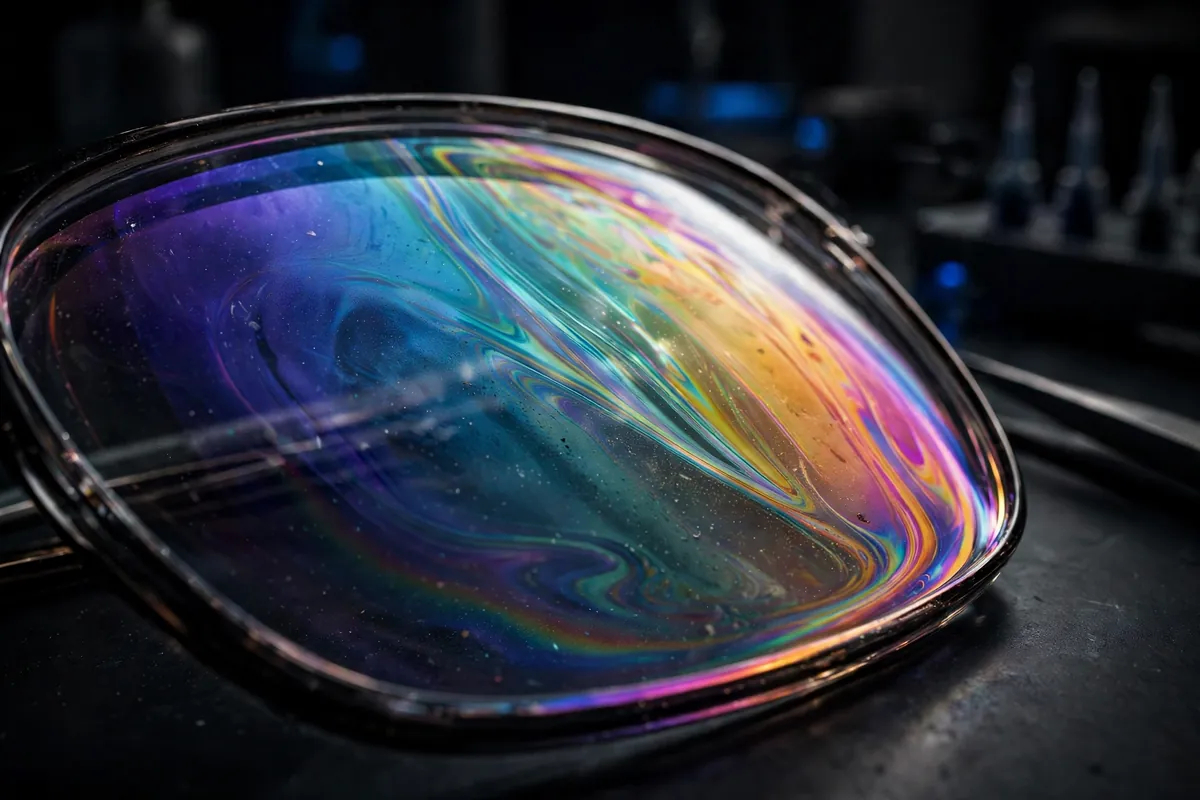
Lens coatings are where optical shops make their margin, so here's the unfiltered breakdown. Anti-reflective coating is the one worth paying for. It kills the ghost reflections that bounce off the front and back of your lenses — the glare in photos, the halo around headlights at night, the faint mirror of your own screen staring back at you. Modern premium AR is genuinely good, and it makes high-index lenses dramatically more wearable. Buy this one.
Scratch-resistant coating is not really a purchase — it should be the baseline. Polycarbonate and high-index lenses are soft enough that they need a hard coat to survive normal life. If a shop lists scratch coating as a paid add-on, ask whether it's already included in the lens price. It usually is. The real question is whether the coating is a cheap dip or a proper baked-on hard coat, and most shops won't volunteer that answer unless you ask.
Anti-reflective is the purchase. UV is the freebie. Everything else is negotiable.
UV protection is the freebie. Nearly every modern lens material — polycarbonate, Trivex, high-index, and even standard CR-39 with basic treatment — blocks essentially all UV on its own. You're not paying extra for UV protection in 2026; you're confirming it's there. The exception is fashion sunglasses with no stated UV rating, which you should never buy. Hydrophobic and oleophobic top coats — the ones that make water bead and fingerprints wipe off easily — are the nice-to-have. They make cleaning easier and are often bundled into premium AR packages. On their own, they're a luxury, not a necessity.
The upsell to question is the "premium blue-light coating" sold as a separate line item. Some of these are just lightly tinted lenses with a big story attached. See page 45 before you pay for one. Talk to your eye doctor about which coatings your lenses actually need.
Optician oversight: Audra Poach, Lead Optician, Go Optical LLC
43 PROGRESSIVES, EXPLAINED Single page →
No line, no swapping, no excuses — one lens for the whole day.
Lens Lab
PROGRESSIVES, EXPLAINED
One lens, three distances, zero lines — progressive lenses explained for people who hate fine print.
Around age 40 to 45, the lens inside your eye stops flexing. Close-up text goes blurry while distance stays sharp — that's presbyopia, and it happens to everyone with a functioning birthday. Before progressives existed, the fix was bifocals: a visible line splitting the lens into distance on top and reading on the bottom, with nothing useful in between. Progressives solved that with a gradient.
A progressive lens has no line because the power changes smoothly from the top of the lens to the bottom. Look straight ahead and you're seeing through the distance prescription. Drop your eyes slightly and you're in the intermediate zone — computer screens, dashboards, the person across the dinner table. Look down and you're in the reading zone. One pair of glasses covers the whole day. That's the entire magic trick: a corridor of changing power, wider at the top, narrowing as it descends.
The corridor is also the catch. The sides of a progressive lens carry distortion — swim and sway at the periphery — because physics doesn't give gradients for free. This is why lens design matters so much. Older or budget progressives have narrow corridors and wide distortion zones; modern free-form digital progressives, surfaced point-by-point by computer-controlled lathes, widen the usable corridor significantly. The lens design tier you choose affects your vision more than the frame does.
Who are they for? Anyone with presbyopia who wants one pair of glasses instead of swapping between distance glasses and readers all day. They're also the default recommendation for first-time presbyopes who spend their days moving between screens and the real world. If you only need reading help and spend most of your day at a desk, occupational or office lenses — progressives tuned for intermediate and near — might serve you better. Talk to your eye doctor about which design fits your day.
Optician oversight: Audra Poach, Lead Optician, Go Optical LLC
44 THE PROGRESSIVE SWITCH Single page →
Lens Lab
THE PROGRESSIVE SWITCH
Your first progressives will feel weird. That's normal. Here's the honest adaptation timeline.
Nobody tells you this at the fitting table: the first week in progressives is an adjustment period, not an instant upgrade. Your brain has to learn a new way of looking at the world, and brains are excellent at it — they just need about one to two weeks of consistent wear. The number one reason people "fail" at progressives is taking them off every time things feel strange. Wear them anyway. The technique is mostly that: don't take them off.
Days one through three feel the strangest. The periphery of the lenses will swim a little when you turn your head. Stairs and curbs may look like they're tilting, because you're catching them through the wrong part of the corridor. The fix is mechanical, not optical: point your nose at what you want to see instead of glancing sideways. Turn your head toward the thing, then move your eyes up or down within the lens to find the right zone. Distance up top, reading at the bottom. It feels deliberate at first. Then it becomes automatic.
By the end of week one, most wearers report the weirdness fading into the background. By week two, the head-turning habit is muscle memory and the glasses feel like glasses. A few realistic expectations: cheap or outdated progressive designs have narrower corridors, which means more head-turning forever — the lens tier matters. Frames that sit too low or slide down your nose will misalign the corridor with your eyes, which is why the fitting and adjustment at pickup is not optional small talk. And if after two to three weeks of full-time wear things still feel wrong — persistent double vision, headaches that don't fade, one eye clearly worse — go back. Sometimes the prescription needs a tweak, sometimes the fitting does.
Progressives are the most returned lens in optical, and almost never because the concept is wrong. It's the adaptation, the fitting, or the design tier. Get those three right and you'll forget they're there. Talk to your eye doctor if adaptation isn't progressing.
Optician oversight: Audra Poach, Lead Optician, Go Optical LLC
45 BLUE LIGHT: THE HONEST TRUTH Single page →

Lens Lab
BLUE LIGHT: THE HONEST TRUTH
Blue light glasses are a billion-dollar category built on a debated evidence base. Here's what we actually know.
Let's be straight about this, because almost nobody selling blue light glasses will be. The marketing story goes like this: screens blast your eyes with blue light, blue light damages your eyes and ruins your sleep, and these special lenses save you. It's a clean story. It's also mostly unproven. The evidence base for blue-light-filtering lenses preventing eye damage or meaningfully reducing digital eye strain is still debated — researchers disagree, the trials are small, and the confident claims on the packaging run well ahead of the science.
Here's what is established. Digital eye strain is real — the burning, the dryness, the end-of-day blur after ten hours of screens. But the leading explanations are blink rate and focusing fatigue, not blue light. You blink about a third as often when staring at a screen, your tear film evaporates, and your focusing muscles lock up. No lens filter fixes blinking. What actually helps: the 20-20-20 rule (every 20 minutes, look 20 feet away for 20 seconds), proper screen distance, good ambient lighting, and anti-reflective coating that cuts the glare bouncing off your lenses. The unsexy stuff works.
Sleep is the one area with a plausible mechanism. Blue-wavelength light in the evening can suppress melatonin, and screens are a delivery device. But the effect size from screens specifically — versus, say, your ceiling lights — is modest, and "night mode" software plus not scrolling in bed does most of the work for free. Where blue light glasses aren't crazy: some wearers genuinely find the slight warm tint more comfortable for long screen sessions, and comfort is a legitimate reason to buy something. Just buy it for comfort, not for the medical claims.
Our position: if a filter makes your long days feel better and the price is sane, wear it. Don't buy it because an ad told you your retinas are in danger. Talk to your eye doctor about your screen symptoms — the fix might be your prescription, not a filter.
The science is debated. The marketing is not. Buy comfort, not fear.
Optician oversight: Audra Poach, Lead Optician, Go Optical LLC
46 PHOTOCHROMICS, UPGRADED Single page →
Twenty-five seconds to dark. Under two minutes to clear. The awkward era is over.
Lens Lab
PHOTOCHROMICS, UPGRADED
The lenses that used to take forever now darken in 25 seconds. Light-adaptive tech finally grew up.
Photochromic lenses had a reputation problem, and it was earned. The old generation darkened slowly, faded even slower, and left you walking indoors wearing sunglasses like you'd forgotten where you were. The molecules did their job — they just did it at the speed of a committee meeting. The new generation is a different product wearing the same name.
Transitions GEN S is the current benchmark: darkens in 25 seconds or less, fades back to clear in under two minutes. That's fast enough that the indoor-sunglasses embarrassment is basically over. The chemistry responds to UV intensity, so the lenses scale their darkness to the actual light — full sun gets full tint, overcast gets a light shade, and they stay clear indoors. For people who move between inside and outside all day, it's the closest thing to a single pair that does everything.
Know the limits before you buy. Photochromics are activated by UV, and car windshields block UV — so they won't darken much behind the wheel. If you drive a lot, you still need dedicated sunglasses. They also don't get as dark as a true sunglass lens at peak sun, and extreme cold can slow the fade-back. None of this is a flaw; it's physics, and any honest optician will tell you the same.
What's next is already shipping, just not for prescriptions yet. Electrochromic sunglasses — lenses that change tint in about a second at the push of a button — arrived as a consumer non-Rx product in 2026, per optogrid.com. They're not ophthalmic grade yet, so your prescription can't ride along, but the direction is obvious: the gap between "sunglasses" and "regular glasses" keeps shrinking. For now, GEN S-class photochromics are the practical sweet spot — one pair, most situations, no swapping. Talk to your eye doctor about whether light-adaptive lenses suit your prescription.
Optician oversight: Audra Poach, Lead Optician, Go Optical LLC
47 FROM EXAM TO PICKUP Single page →

Lens Lab
FROM EXAM TO PICKUP
The prescription glasses guide: the exam, the frames, the lenses, and the questions that save you money.
Buying prescription glasses is a four-step process, and most people only think about step three. Step one is the exam — and it's changed. EssilorLuxottica performed over 200,000 teleoptometry exams in 2025, up 40% year over year, and digital PD measurement via a simple photo is now accurate to within half a millimeter. Remote eye care is real and growing, though a comprehensive in-person exam still catches things a camera can't. Get the exam your eyes need, then get the numbers: your full prescription and your pupillary distance. You own that data. Take it with you.
Step two is frames, and fit beats fashion. The frame should sit level, the lenses should center on your eyes, the bridge shouldn't pinch or slide, and the temples should hug without pressing. Strong prescriptions want smaller, rounder, full-rim frames — they hide edge thickness and keep the optics centered. This is the step people rush and regret. Try them on, move your head, look down. If they slide in the shop, they'll slide forever.
Step three is lenses: material and coatings, covered on pages 41 and 42. Match the material to your prescription strength and your life, get anti-reflective coating, confirm UV protection, and think twice about every add-on. Step four is the questions. Ask: what progressive design tier is this? Is the scratch coating included or extra? What's the warranty and remake policy? Can I see the lens thickness estimate before you cut them? A good optician answers all four without flinching. A shop that can't answer them doesn't deserve your prescription. Talk to your eye doctor — not a salesperson — about what your eyes need.
Own your prescription, interrogate the add-ons, and never rush the fitting.
Optician oversight: Audra Poach, Lead Optician, Go Optical LLC
48 READ YOUR PRESCRIPTION Single page →
Lens Lab
READ YOUR PRESCRIPTION
OD, OS, sphere, cylinder, axis, ADD — the numbers on the card, decoded in plain English.
Your prescription looks like a secret code, but it's just six measurements and a Latin hangover. OD is your right eye (oculus dexter), OS is your left (oculus sinister). Everything else is a column under one of those two headings. Once you know what each row means, you'll never feel blind at the optical counter again.
Sphere (SPH) is the main event: the lens power that corrects nearsightedness or farsightedness, measured in diopters. Minus numbers mean nearsighted — you see close, not far. Plus numbers mean farsighted. The bigger the number, the stronger the correction, and the more your lens material choice matters. A -1.50 can wear almost anything; a -8.00 needs high-index and a smart frame choice. Cylinder (CYL) and Axis together describe astigmatism — an irregular curve in your eye that blurs vision at certain angles. Cylinder is the amount of correction; axis, a number from 1 to 180, is the orientation. If those columns are blank, you don't have astigmatism. Lucky you.
ADD is the addition: extra magnifying power for close-up work, and it only appears if you're presbyopic — generally 40-plus. It's what turns a single-vision prescription into progressives or bifocals. Then there's PD, pupillary distance, sometimes on a separate measurement: the millimeter distance between your pupils, which centers the optics on your eyes. Get it wrong and even a perfect prescription feels off. Finally, prism is rare — a correction for eye alignment issues that most prescriptions never include.
Practical takeaway: the sphere tells you how strong, the cylinder and axis tell you how complex, and the ADD tells you whether you're in progressive territory. Keep a photo of your prescription on your phone. It's yours. Talk to your eye doctor if any number on your card confuses you — that's literally their job.
Optician oversight: Audra Poach, Lead Optician, Go Optical LLC
49 THIN IS IN Single page →
The thinnest lens is a small frame away. Material is only half the trick.
Lens Lab
THIN IS IN
High-index, demystified: 1.67 vs 1.74, when thinner is worth the money, and how to cheat thickness for free.
High-index lenses do one thing: bend light more efficiently, so less material is needed to hit your prescription. The number — 1.67, 1.74 — is the refractive index. Higher number, thinner lens. Standard plastic sits around 1.50, so jumping to 1.67 cuts noticeable thickness, and 1.74 cuts more. But thinner is not automatically better, and the price jumps are real.
Here's the honest breakdown. For mild to moderate prescriptions (roughly up to ±3.00), high-index is mostly cosmetic — your lenses are already reasonably thin, and the money buys you millimeters. Between ±3.00 and ±6.00, 1.67 is the sweet spot: visibly thinner, lighter on the nose, worth it for most wearers. Past ±6.00, 1.74 earns its price — at those powers, standard lenses get genuinely thick and heavy, and high-index is the difference between glasses you wear and glasses you tolerate. One caveat: higher index means lower Abbe value, meaning slightly more chromatic fringe at the edges. Pair high-index with good anti-reflective coating and the trade-off mostly disappears.
But the cheapest thickness reduction isn't a material at all — it's the frame. Smaller lens openings mean thinner edges, because lens thickness grows with diameter. Round and oval shapes hide edge thickness better than big rectangles. Full rims conceal the edge entirely; rimless and semi-rimless put it on display. Center the prescription in the frame — decentration adds thickness — and consider aspheric designs, which flatten the curves and slim the profile further.
So the formula: right index for your power, small frame, full rim, aspheric design. Do all four and even a strong prescription can look like off-the-shelf glasses. Talk to your eye doctor about which index your prescription actually needs.
Optician oversight: Audra Poach, Lead Optician, Go Optical LLC
50 LENS CARE COMMANDMENTS Single page →

Lens Lab
LENS CARE COMMANDMENTS
Cleaning, storage, microfiber rules — and the scratch-repair myths that need to die.
Your lenses are precision optics with coatings measured in nanometers. Treat them like it. Commandment one: rinse first. Dust and grit are tiny rocks — wipe a dry lens and you're grinding them across the surface. Run lukewarm water over the lenses, then a drop of plain dish soap, then rinse again. Commandment two: the microfiber cloth is law. Not your shirt, not a paper towel, not a tissue — all of those are abrasive enough to haze coatings over time. Use a clean microfiber, and wash it regularly, because a dirty microfiber is just sandpaper with better branding.
Commandment three: store them like they cost money, because they did. Hard case, lenses up, every single time they leave your face. The number one cause of scratched lenses is not cleaning — it's the pocket, the purse, and the dashboard. Heat is the silent killer: don't leave glasses in a hot car. Extreme heat can craze anti-reflective coatings into a spiderweb of micro-cracks that no cleaning will fix. Commandment four: both hands. Taking glasses off one-handed torques the frame and loosens the fit over time. Small habit, big difference.
Now the myths. Toothpaste does not fix scratches — it's an abrasive that hazes the surrounding coating and makes things worse. Baking soda paste, car wax, and the other internet remedies do the same: they polish the area around the scratch, not the scratch itself. There is no home remedy that removes a scratch from a coated lens. A scratch through the anti-reflective coating is permanent; the only fix is a new lens. Anyone selling you a scratch-repair kit for coated lenses is selling hope in a bottle.
The real secret to scratch-free lenses isn't a product. It's the rinse, the cloth, and the case. Boring, free, and it works. Talk to your eye doctor or optician if a scratch is affecting your vision.
Rinse, microfiber, case. There is no fourth step, and toothpaste is not it.
Optician oversight: Audra Poach, Lead Optician, Go Optical LLC