
Issue #1 — The Debut · Trend Radar
Trend Radar: the whole section
The season's frames, smart glasses, and what to buy, skip, or wait for — every Trend Radar story from the debut issue, in order. Prefer it page by page? Start at page 21, or browse the Trend Radar hub.
21 2026: THE YEAR OF EXTREMES Single page →
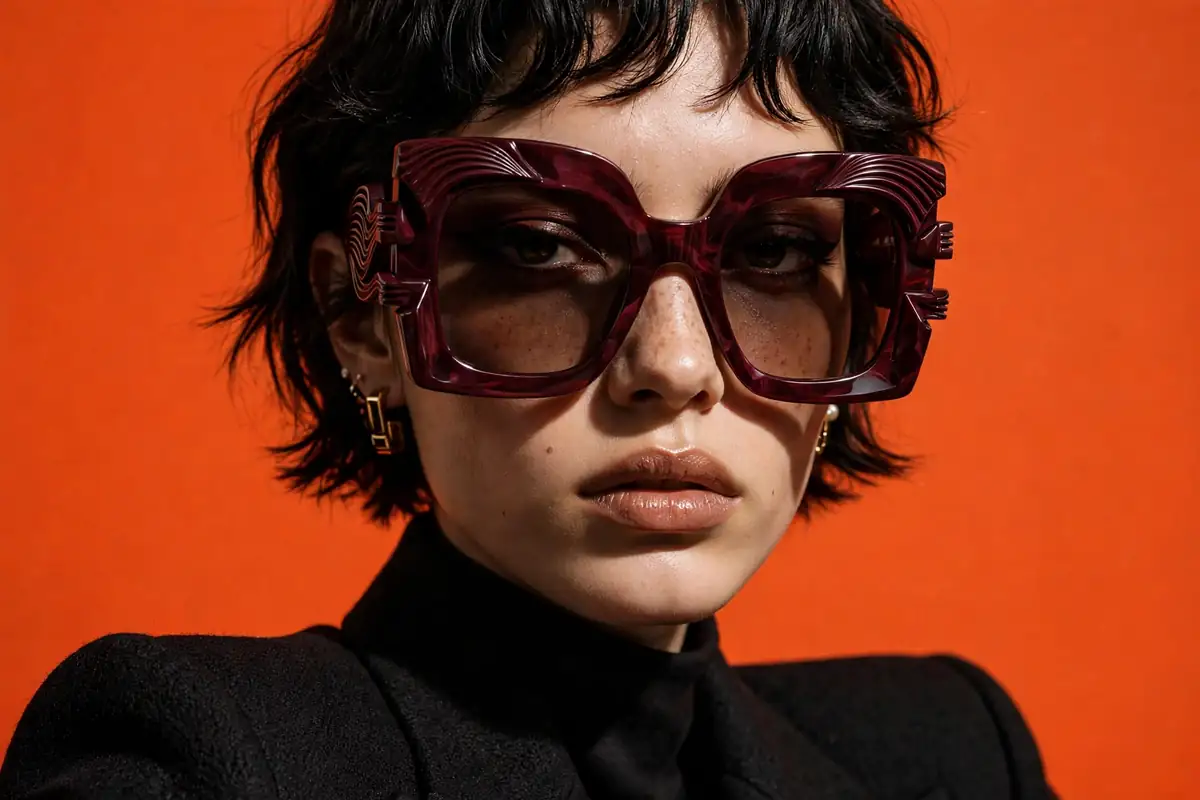 Trend Radar
2026: THE YEAR OF EXTREMES
Maximalist acetate meets invisible titanium — and there's no middle ground.
Forget trends that whisper. This year, eyewear picked a fight with itself. On one side: sculptural oversized acetate, wide fronts, thick temples, curves with ambition. On the other: titanium so light you forget you're wearing it — wire frames at 18 to 22 grams, rimless, nearly invisible. No middle ground. No compromise. Just two tribes. You pick one.
It's the defining story of eyewear trends 2026. Every brand has planted a flag. Fashion houses are swinging for the fences with XXL acetate that reads as architecture on your face. The minimalists went the other way: Scandinavian quiet luxury, hexagonal geometry, Lindberg still setting the benchmark for frames that disappear.
Why the split? Because glasses aren't subtle anymore. They're identity gear. The oversized crew wants to be seen — thick 3 to 4mm temples are a statement, not an accident. The minimalist crew wants precision — eyewear as engineering, not decoration. Both are right. That's what makes this year fun.
The middle didn't die, exactly. But it's quiet. Safe tortoise rectangles still sell, because they always do. The energy, though — the stuff fashion week actually photographed, the stuff your group chat argues about — lives at the extremes.
Here's the thing nobody admits: the extremes feed each other. The bigger the acetate gets, the more radical the titanium looks by contrast. The lighter the minimalism, the bolder the maximalism feels. They're not just coexisting — they're in an arms race, each one making the other more extreme. That's why this year feels different from past "big vs. small" cycles. Neither side is backing down.
Consider this issue your map of the battlefield. Which side are you?
22 SHAPE OF THE YEAR Single page →
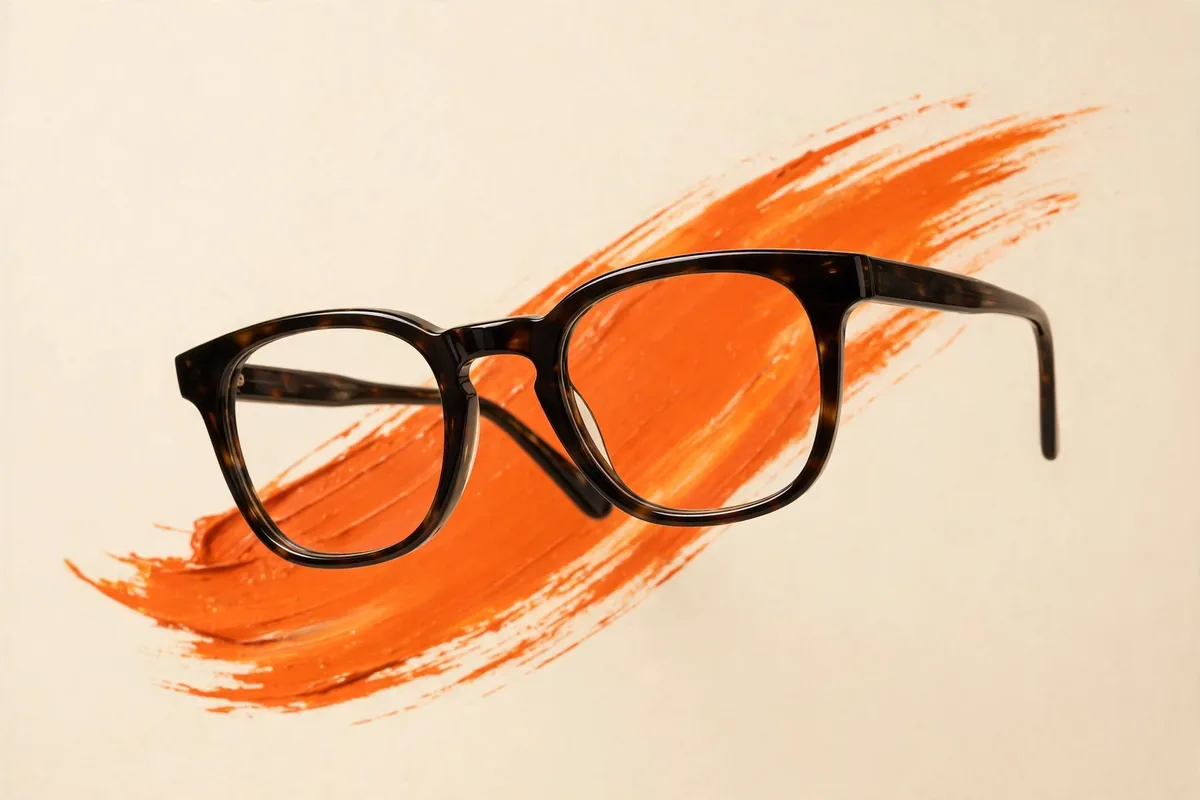
Trend Radar
SHAPE OF THE YEAR
The rounded rectangle rules 2026. Here's why it works.
One silhouette beat everything in 2026: the rounded rectangle. Straight top edge. Softened bottom corners. Nothing fancy. But it flatters almost everyone, and that almost never happens.
Here's the trick. A pure rectangle sharpens — great if you want angles, harsh if your face already has them. A full oval softens — cozy, sometimes forgettable. The rounded rectangle splits the difference: the straight brow line gives structure, the eased lower corners keep it friendly. It borrows from both families and offends no one.
Scale did the heavy lifting this year. Fronts run wide — 140 to 150mm across — so the shape reads bold even though the lines are calm. Think of it as the adult in the room: confident, not loud. That's why it crossed over from fashion people to regular humans faster than any shape in years.
It works on square jaws because the softened corners don't echo hard lines. It works on round faces because the straight top adds definition. It even works on small faces if you size down and keep the lens depth shallow. Oval faces, as always, get a pass on everything.
When you shop it, check the brow line. The best versions keep it level and clean — no keyhole sag, no exaggerated dip. If the frame hides your eyebrows, it's too big. If your eyes sit in the top third, it's perfect.
Color-wise, the rounded rectangle is a chameleon. It carries the year's deep reds and mineral tones beautifully, but it also rescues boring black — the softened corners keep black from reading harsh. In smoked crystal or translucent caramel, it's the single most versatile frame of 2026. This one isn't a trend you'll regret in photos. It's a classic with better proportions, and it earned the crown.
The rounded rectangle is the rare shape that flatters almost every face on the planet.
23 GO BIG OR GO HOME Single page →
Trend Radar
GO BIG OR GO HOME
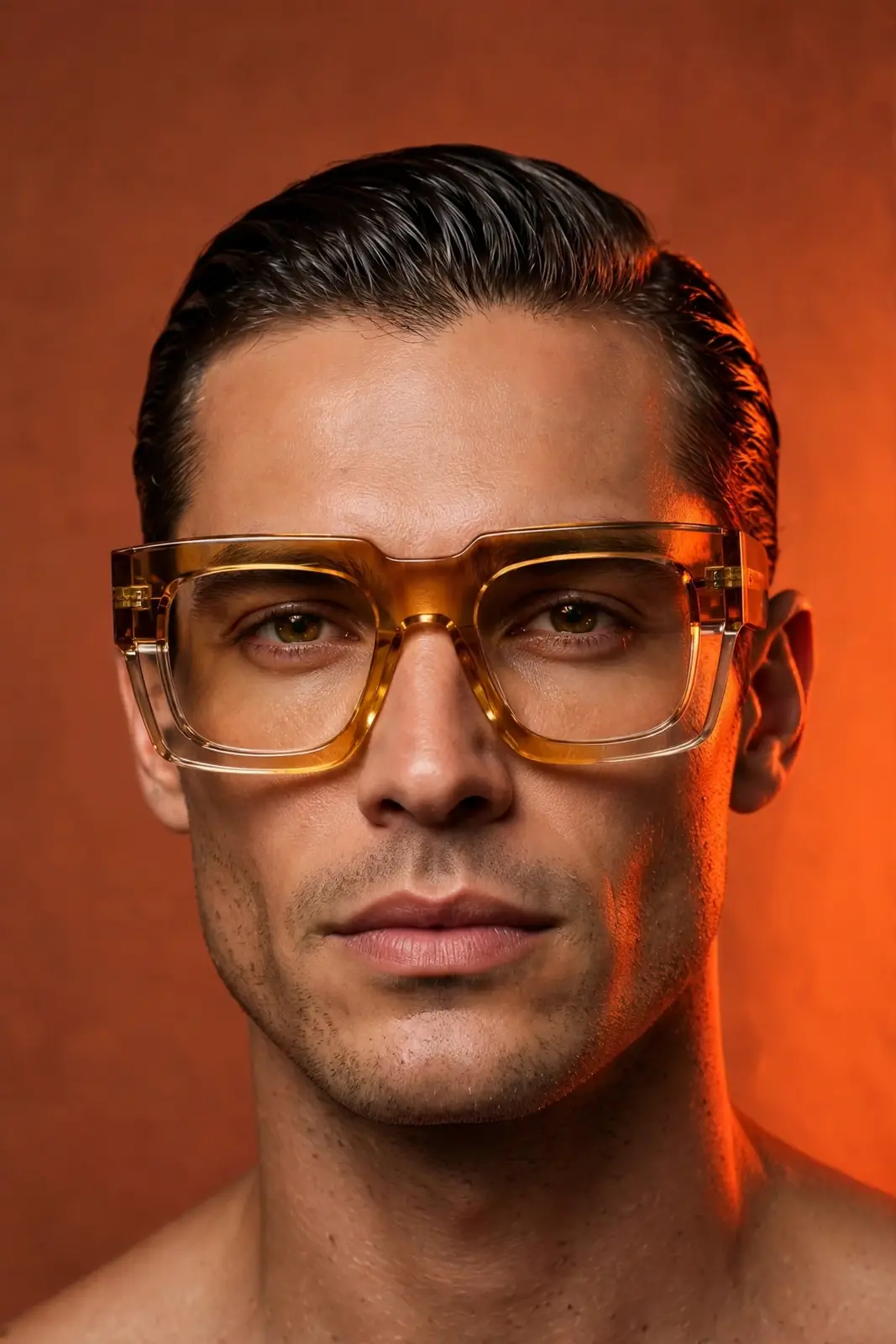
Sculptural acetate: wide fronts, thick temples, zero apologies.
Maximalism won this round, and it won on size. The 2026 acetate playbook is simple: fronts up to 150mm wide, temples at a hefty 3 to 4mm, and curves that replaced last decade's sharp corners. These are not glasses. They're headpieces that happen to hold lenses.
The references tell you where this came from. Ray-Ban's Mega Wayfarer proved the appetite. Gucci's XXL acetate made it fashion. Fendi's geometric statements and Burberry's bold squares filled out the chorus. The industry saw the response and pushed the proportions even further — softer, rounder, heavier.
If your glasses aren't the loudest thing you own, you're not doing 2026 right.
The construction is the flex. Acetate is still the dominant frame material, now cut in richer laminations with more depth. Bio-acetate is rising fast — Etnia Barcelona, Prada's Re-Nylon line, and Lacoste's eco-frames all pushed it in 2026, and Tanabiku built frames from a proprietary 10mm bio-acetate slab. Sustainability is becoming a luxury signal, not a compromise.
Wear it like this: let the frames do the talking and keep everything else quiet. Big acetate plus a loud outfit is a fight. Big acetate plus a white tee is a thesis. And don't fear the weight — modern hinge engineering means even chunky frames sit better than the heavy plasticky pairs of the past.
One more thing: size is not one-size. Oversized on a broad face is proportionate; on a narrow face, it's a mask. The 140 to 150mm fronts that define this trend assume an average-to-wide face. If yours is petite, look for the same sculptural language scaled down — thick temples, soft curves, just less wingspan. The statement survives at any size.
24 THE INVISIBLE FRAME Single page →
Trend Radar
THE INVISIBLE FRAME
Titanium minimalism: 18 grams of pure restraint.
The other pole of 2026 is the opposite of spectacle: titanium wire frames weighing 18 to 22 grams. Rimless. Semi-rimless. Frames so light you check if they're still on your face. This is eyewear for people who find maximalism exhausting.
The appeal is engineering. Titanium's strength-to-weight ratio means a frame can be whisper-thin and still survive daily life. It's hypoallergenic. It holds its shape. "Memory metal" alloys bounce back from the indignities of bags and seat cushions. Hexagonal and octagonal geometry gave the look a fresh edge this year — classic shapes with a sharper, more architectural vocabulary.
The benchmark is Lindberg. The Danish house defined Scandinavian quiet luxury in eyewear years ago, and every minimalist frame in 2026 is still measured against it. But the look has spread well beyond one brand. Fine metal aviators, sleek semi-rimless rectangles, double-bridged rounds — the minimalist shelf is deeper than it's ever been.
This is also the insider's power move. Big acetate says something about you. Titanium says nothing, and in the right room, that says everything. It's the frame equivalent of a perfectly cut suit: no logo, no noise, total control.
There's a practical upside nobody talks about: at 18 to 22 grams, titanium is the most comfortable way to wear strong prescriptions. Heavy lenses need light frames, and nothing is lighter. If your prescription is thick, minimalism stops being an aesthetic and becomes ergonomics.
Fit matters more here than anywhere else. Rimless and semi-rimless frames show every misalignment. Get the bridge and temples adjusted by a pro. Then disappear, beautifully.
25 DRINK THE BURGUNDY Single page →
Trend Radar
DRINK THE BURGUNDY
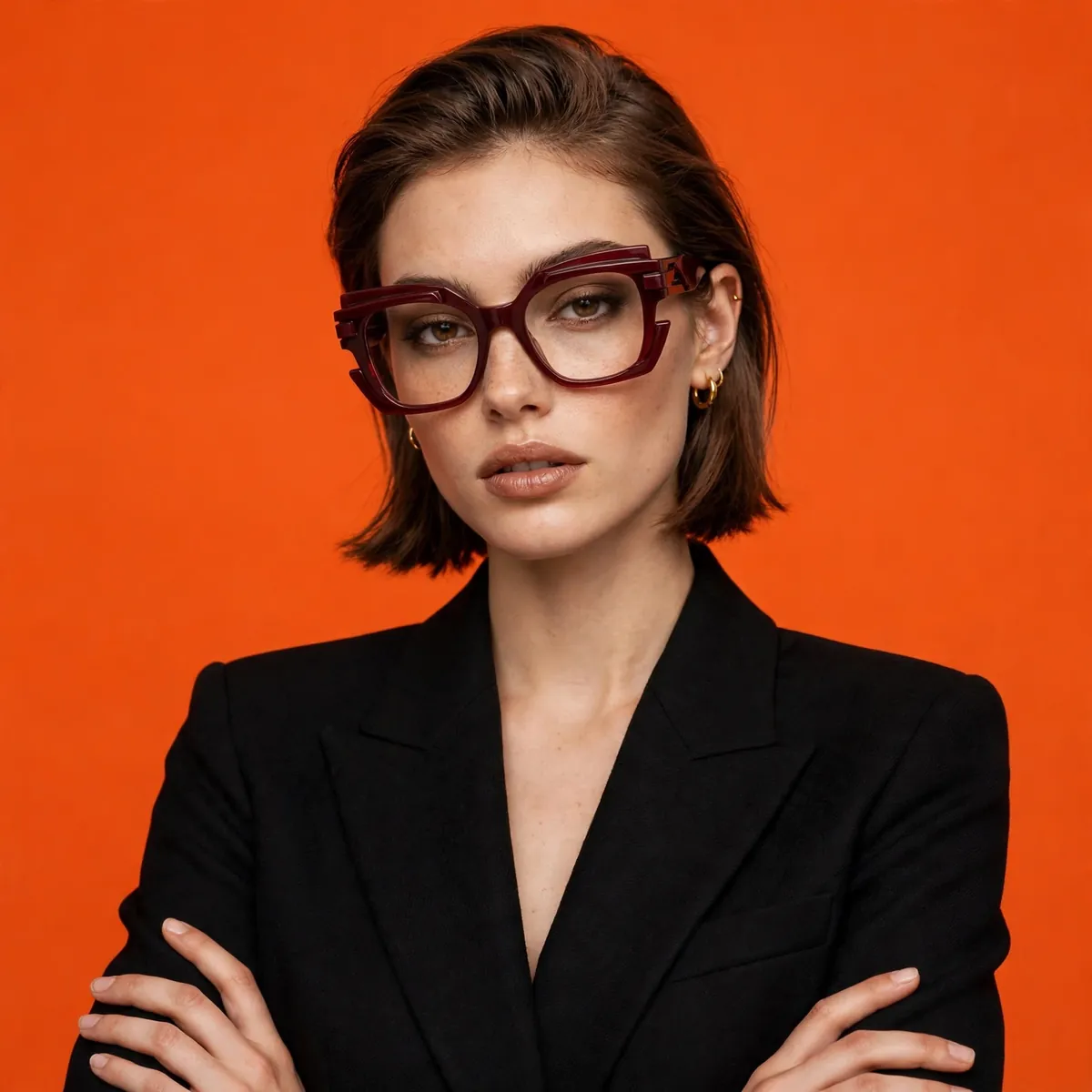
Deep reds and rich browns are the colors of the year.
If eyewear trends 2026 had a signature color, it would be burgundy. The deep reds and rich browns — burgundy, mahogany, cognac, dark tortoise — owned every fall/winter 2026 trend roundup, and the receipts are official: LAKOH's September 17, 2026 update flagged the family, citing both MIDO 2026 and Pantone's A/W 2026–27 palette. This isn't a vibe. It's a consensus.
Why does it work? Dark tortoise is the most forgiving neutral ever put on a face — warmth without orange, pattern without chaos. Burgundy goes one step further: it reads as red from across the room and brown up close, which means it plays with every skin tone and most of your closet. Cognac and mahogany do the quieter version of the same trick, glowing against neutral wardrobes.
The styling move this year is tone-on-tone. Deep red frame, dark tortoise lens edge, amber-tinted lens. Or a burgundy acetate with gold hardware — warm metal on warm plastic, endlessly flattering. Pair with camel coats, black turtlenecks, olive layers. Avoid neon. Avoid white sneakers energy. This palette wants autumn, forever.
Watch out for one thing: cheap burgundy can look plasticky under bad light. The good versions have depth — layered acetate with translucent streaks, not flat opaque red. Hold the frame up to a window. If light passes through with warmth, it's the real thing. If it's a brick wall of red, put it back.
And here's the insider angle: this color family is where the year's material story shows up strongest. Richer acetate laminations — the layered, marbled, almost edible-looking sheets that defined 2026 — were built for exactly these tones. Burgundy in a cheap flat sheet is a red flag. Burgundy in deep lamination is the whole trend in one frame.
26 MINERAL MOOD Single page →
Trend Radar
MINERAL MOOD
Olive, forest, ink blue, slate — nature's quiet power palette.
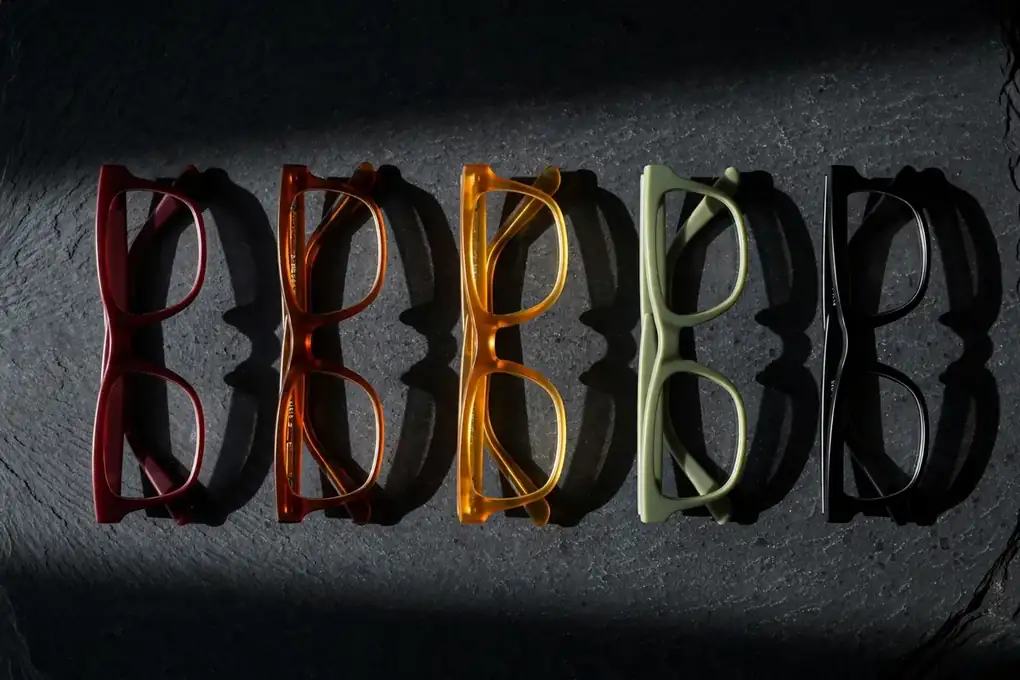
While burgundy grabbed the headlines, 2026's other color story ran deeper — literally underground. The mineral tones: olive, forest green, ink blue, slate and cool gray. Colors pulled from stone, moss, and deep water instead of fruit and fire.
These are the thinking person's neutrals. Olive is warm enough to flatter skin but weird enough to feel intentional. Forest green in acetate has a jewel depth that black can never touch — it reads serious without reading severe. Ink blue is the sleeper hit: dark enough to function as a neutral, blue enough to make your eyes look sharper. Slate and cool gray are the true minimalists' answer, perfect against the titanium trend.
Minerals don't shout. They endure. So will these frames.
The fashion logic is simple. Mineral tones sit between nature and architecture. They pair with everything burgundy pairs with, but they whisper instead of declaring. A forest acetate frame with a gray sweater is one of the best-looking combinations in eyewear right now — try it and tell us we're wrong.
Two notes. First, mineral colors love texture: laser-engraved acetate mimicking stone or wood grain showed up across 2026 collections, and it elevates these tones from flat to fascinating. Run your thumb over the frame — if you can feel the grain, you're holding the trend at its best. Second, check them in daylight. Ink blue can collapse into black under store lighting. It should hold its blue edge in the sun. Check that before you pay.
Styling-wise, minerals are the easiest palette of the year. They sit naturally next to denim, leather, wool, and metal — basically the entire contents of a normal wardrobe. If burgundy is the color you plan an outfit around, minerals are the colors that plan themselves.
27 CLEARLY OBSESSED Single page →
Trend Radar
CLEARLY OBSESSED
Smoked crystal, translucent caramel, smoky champagne — light is the material.
The boldest move in 2026 color wasn't a color at all. It was transparency. Smoked crystal. Translucent caramel. Smoky champagne. Misty gray. Ocean blue. Acetates that let light pass through instead of stopping it dead. Subtle gradients that fade from tinted to clear across the frame front.
This trend does something no opaque frame can do: it borrows from your face. A smoky champagne frame picks up your skin's warmth. A translucent caramel deepens against darker complexions and softens against lighter ones. The frame stops being a separate object and starts being part of you. It's the most flattering trick in the book, and it requires zero courage to wear.
Smoked crystal deserves its own spotlight. The gray-tinted clear acetate reads modern, architectural, almost liquid — like eyewear carved from ice. It pairs perfectly with the titanium minimalism story, and it photographs like a dream. If you want in on the transparent trend without going full crystal, misty gray and subtle gradients are the on-ramp.
The honest caveat: translucency shows everything. Cheaper clear frames reveal every bubble and imperfection in the acetate, and dirty lenses show twice as hard against a clear frame. Buy well — this is a trend where material quality is visible to the naked eye. Literally.
Gradients deserve a special mention. The fade-from-tinted-to-clear front — darker at the top, dissolving toward the bottom — is the most elegant version of this trend. It gives you the drama of a tinted frame with the airiness of a clear one, and it flatters every face shape because the eye reads the darker top as a brow line. If you're buying one transparent frame this year, make it a gradient.
28 RETRO, REBOOTED Single page →
Trend Radar
RETRO, REBOOTED
Cat-eyes, pilots, ovals, and aviators — rewritten, not repeated.
Retro never left eyewear. It just got edited. The 2026 versions of classic shapes are recognizably descended from their ancestors — but every one has been modernized enough that you won't look like you're wearing a costume.
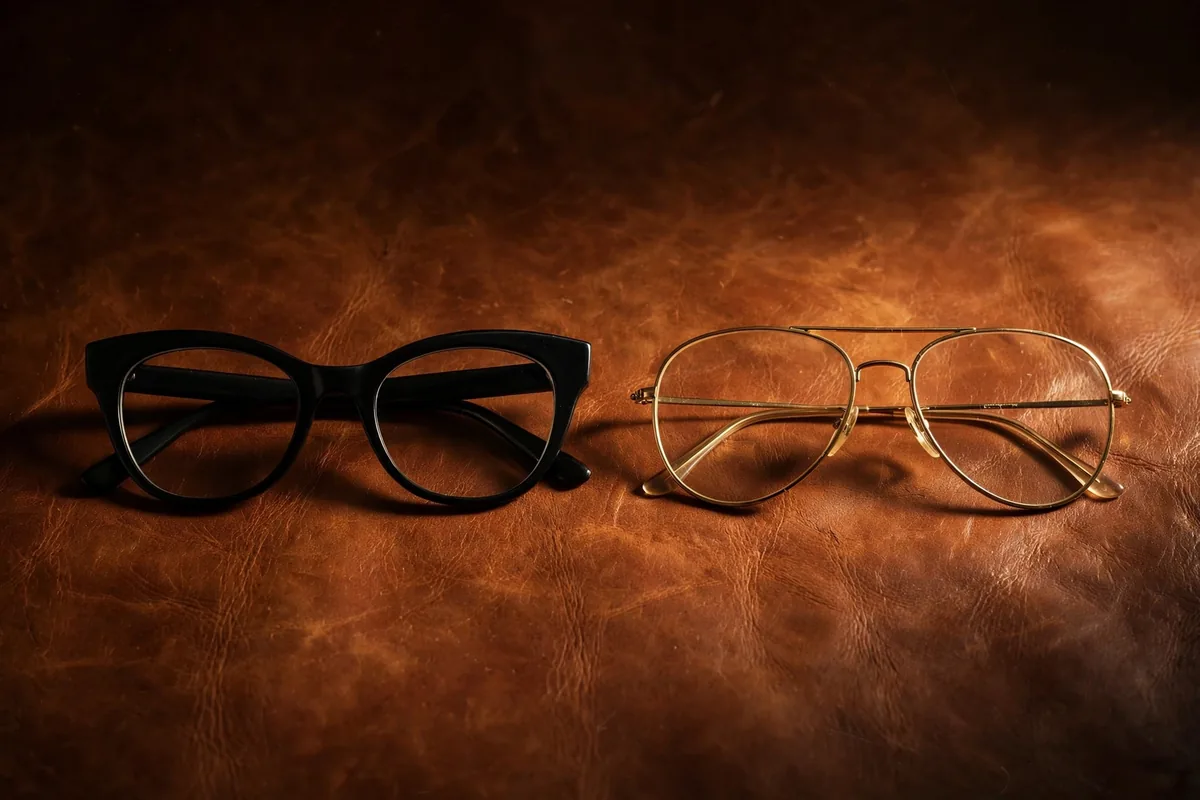
Start with the cat-eye. This year's version has a subtle 15 to 20-degree upturn at the corners — not the dramatic 30-degree-plus points of vintage originals. It's narrower and elongated toward the temples, a shape one European roundup described as "lifting, almost predatory." Less pin-up, more predator. It works because restraint made it wearable: the attitude survived, the costume didn't.
Pilots, ovals, and rounds got the same treatment. Cleaner lines, updated scale. Rounds evolved into larger-diameter "perfect spheres," often with double bridges — and they've gone increasingly unisex, worn by everyone, styled by no one in particular. Retro rectangles returned with their angles softened. And the aviator — the most reinterpreted shape of them all — showed up in fine metal and sleek acetate, from Tom Ford's thick retro-acetate FT5812 to Cartier's geometric gold Santos and Panthère lines.
The lesson: retro works when designers keep the soul and change the proportions. Nod to the past. Live in the present. The frames that fail are the ones that cosplay.
What ties all of these together is wearability. The 2026 retro reboots are designed for people who want the reference without the costume — the cat-eye's edge without the vintage points, the aviator's swagger without the pilot cosplay, the round's charm without the Harry Potter jokes. Retro stopped being a theme. It became a toolkit. Use it.
Good retro is a translation, not a photocopy.
29 RUNWAY TO SIDEWALK Single page →
Trend Radar
RUNWAY TO SIDEWALK
Prada went minimal. Gucci went moody. Here's how to wear both.
Fashion week doesn't design for your commute. It designs for fantasy. But the FW26 eyewear moments gave us two clear, wearable playbooks — if you know how to translate them.
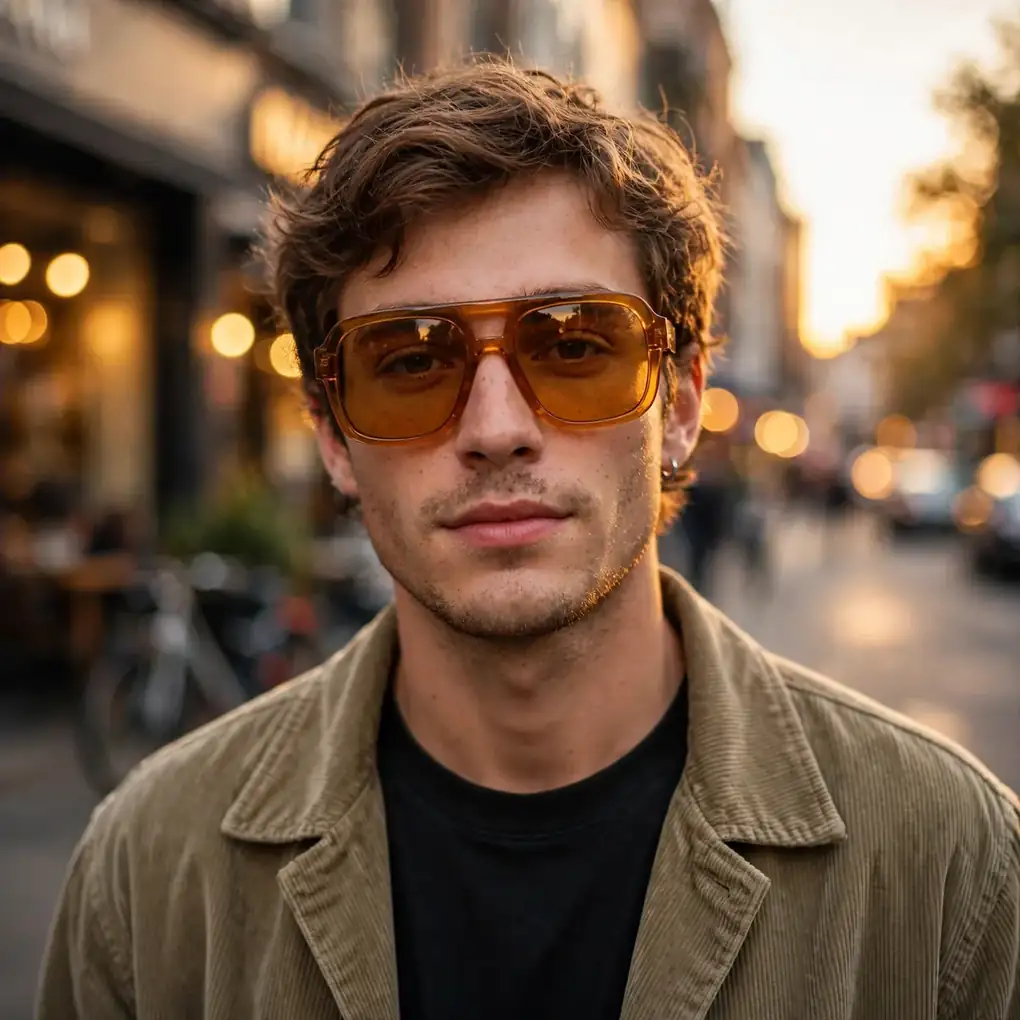
Prada's FW26 "Simple Stories" show in September 2026 went full minimalist: silver metal aviators with amber lenses, silver oval frames on models like Troye Sivan and Chen Haoyu. High-fashion tone, whisper-quiet execution. The sidewalk version: a fine silver or gunmetal aviator — or a slim oval — worn with absolutely nothing competing. Monochrome outfit. Clean hair. Let the metal lines be the jewelry. The amber lens is the secret move: it warms your face like a permanent golden hour.
Gucci Eyewear went the opposite direction in its September 2026 campaign: cat-eye with gold hardware, gold-rimmed ovals, oversized black frames — a moody, studio-lit fever dream. The sidewalk version: the modernized cat-eye in dark tortoise or black with warm metal details, paired with structured clothes — a blazer, a strong lip, boots. Mood is the accessory here. Dress like you have somewhere secret to be.
The underlying message from both houses: commitment. Prada says strip it back. Gucci says turn it up. The worst move is halfway — a timid cat-eye with a timid outfit, or an aggressive aviator you apologize for. Pick your lane and drive it.
And here's the translation secret the runways won't tell you: both looks are built on fit, not fashion. The Prada silver aviator only reads minimal if it actually fits your face — too big and it's costume, too small and it's lost. The Gucci cat-eye only reads moody if the upturn lifts your features instead of fighting them. Try them on. Move your head. The runway is fantasy; the mirror is the editor.
Runway eyewear isn't about the frames. It's about the nerve.
30 THE GLASSES GOT SMART Single page →
Trend Radar
THE GLASSES GOT SMART
7 million pairs in 2025. The inflection point already happened.
Here's the number that changed everything: EssilorLuxottica sold more than 7 million pairs of Meta AI glasses in 2025 — more than triple the combined total of 2023 and 2024, per their Q4 results reported in February 2026. About one in five was fitted with prescription lenses. These weren't gadgets for early adopters. They were glasses. On real faces.
2026 became the inflection year. Meta's Ray-Ban Gen 3 launched at Connect in September. Samsung unveiled Galaxy Glasses at Galaxy Unpacked on July 22, with Android XR and Gemini — and a launch expected in November. Warby Parker announced its own AI eyewear collection with Google. Even Realities' G2 earned a 2026 IFA Innovation Award. In Q3 2026, EssilorLuxottica's revenue rose 9.0% to €7.49 billion (+7.2% at constant currency), with wearables up 20% (company release, Oct 20, 2026). This is not a demo. It's a category.
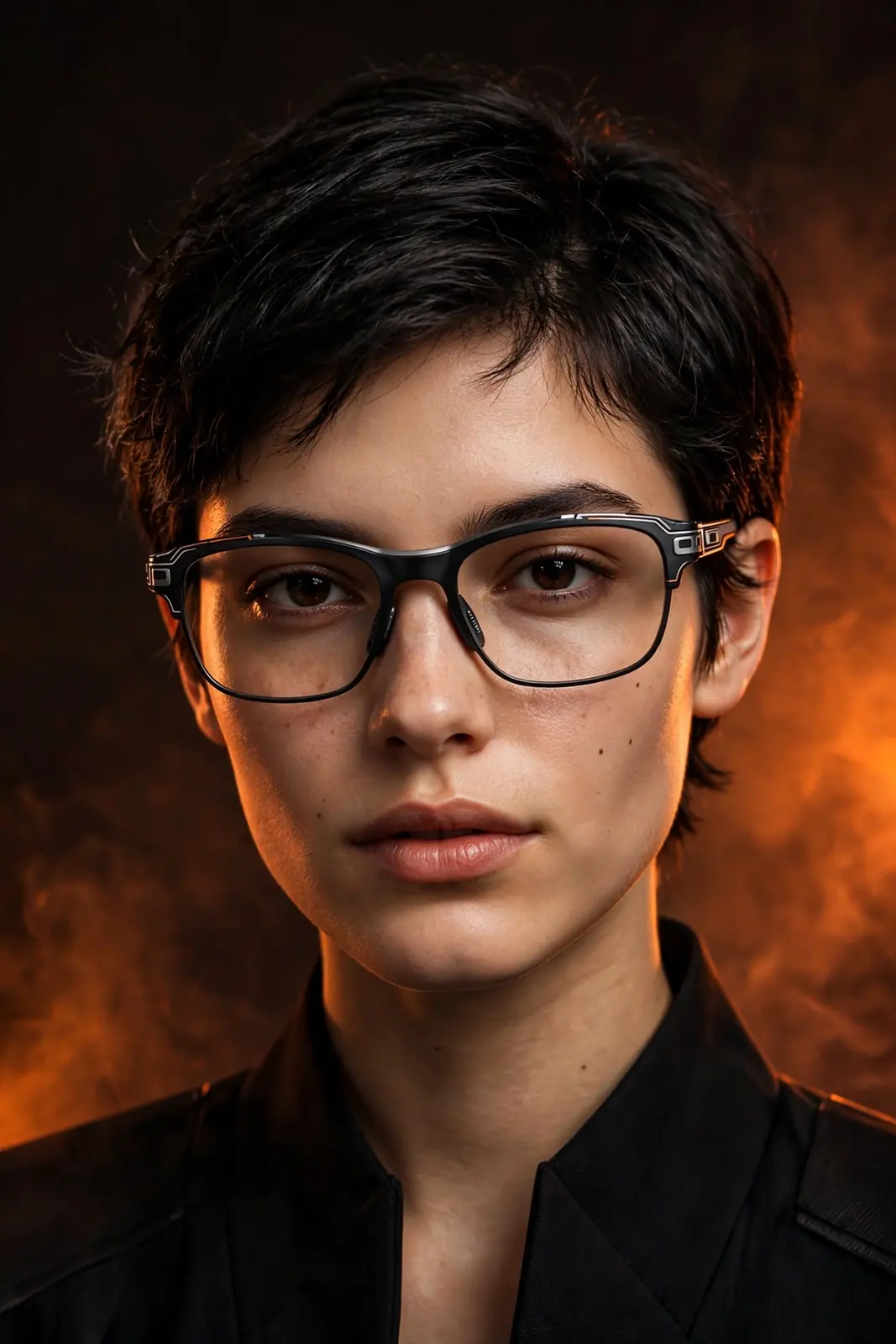
What flipped the switch? The tech finally stopped looking like tech. The winning smart glasses look like Wayfarers, not headsets. AI that answers questions, translates speech live, navigates on foot — all in something you'd actually wear to dinner. The gadget era of smart glasses is over. The fashion era began.
Barclays projects 60 million smart glasses units globally by 2035. We're telling you now: by the time your next prescription expires, "smart" may just mean "glasses."
Sources: EssilorLuxottica Q3 2026 release; CNBC on EssilorLuxottica's 2025 results; Even Realities.
The future of eyewear doesn't look like the future. It looks like a Wayfarer.
Corrected Oct 20, 2026 — see Standards & Corrections.
31 META'S $299 GAMBIT Single page →
Trend Radar
META'S $299 GAMBIT
The price that turned AI glasses into an impulse buy.
The Meta Glasses launched in June 2026 at $299 — three hundred dollars — for AI glasses with Meta's "Muse Spark" multimodal intelligence, dynamic photo capture, pedestrian turn-by-turn navigation, and live translation in 20 languages. The price of a decent pair of designer frames. The price that changed everything.
Three hundred dollars is the magic threshold. Below it, smart glasses are an experiment you justify. Above it, they're a gadget you debate. At $299, Meta priced AI glasses like fashion — comparable to a pair of Ray-Bans, not a piece of tech. And the September 2026 launch of Ray-Ban Gen 3 at Connect doubled down, with Meta's Instagram account promising roughly 100 new AI glasses styles by year's end.
The strategy had layers. A firmware update extended the AI features to older Ray-Ban and Oakley Meta frames, so early buyers weren't abandoned. The Meta × Lisa collaboration brought Adventurer and Capri LISA Editions at $399 — fashion credibility plus real fit engineering, with three-way adjustable nose pads across the Meta Glasses line. Nova arrived alongside as a new Meta Glasses style of its own. And the Ray-Ban Meta Audio, at $349 and shipping October 13, 2026, offered an AI option with no camera at all. New York's courts drew a wider line than that, though: the Unified Court System's July 2026 memo bans any eyewear that can record video or audio — camera, microphone or computer inside — from court facilities, so audio-only glasses are prohibited there too.
Meta didn't win 2026 by building the most advanced glasses. It won by building the most buyable ones. And buyable compounds: every pair sold is another person normalizing AI glasses in public, another prescription fitted, another data point proving the category. The $299 price wasn't just a number. It was a strategy for making the strange feel ordinary — which is exactly how every world-changing gadget has ever won.
Sources: Meta — Meta Glasses from $299; Meta — Ray-Ban Meta Audio; NY Unified Court System — smart glasses prohibition memo (July 2026).
Corrected Oct 19, 2026 — see Standards & Corrections.
32 THE $2,195 QUESTION Single page →
One tier wants to be your glasses. The other wants to be your computer.
Trend Radar
THE $2,195 QUESTION
Fashion accessories or AR flagships? The market split in two.
While Meta conquered the mainstream at $299, the other end of the market went full flagship. Snap's Specs — see-through AR glasses built on a multi-year Qualcomm Snapdragon XR deal struck in April 2026 — were priced around $2,195 for a late-2026 launch. Meta's own Display glasses, shipping in the US since September 2025 at $799 with a 600×600px built-in display and 12MP camera, sit in the middle. Two tiers emerged, and they're barely the same product.
Tier one: fashion/AI accessories, no display. Meta Glasses at $299. Ray-Ban Meta Audio at $349 — prescription-friendly, no camera, a direct answer to privacy anxiety. These look like glasses, act like an AI assistant, and cost like fashion. This tier won 2026.
Tier two: full AR display flagships. Snap Specs at $2,195. Meta Display at $799. Xreal's Project Aura with its 70-degree field of view. Even Realities' G2 sits between the tiers at $599: no camera, but a discreet micro-LED display, prescription-friendly, and a 2026 IFA Innovation Award winner. These overlay digital worlds onto your vision — genuinely futuristic, genuinely expensive, genuinely early. This tier is winning the headlines, not the sales.
So which one are you? That's the $2,195 question. The fashion tier asks: do you want glasses that are smarter? The AR tier asks: do you want to replace your phone? Different answers, different buyers, different futures. For now, the money — and the mainstream — sits firmly in tier one.
The smart play is to watch the gap between the tiers, because it won't stay this wide. Displays get smaller and cheaper every year; fashion gets bolder about absorbing tech. The $799 Meta Display is already the bridge product — a flagship wearing mainstream pricing. Where the tiers meet is where the next decade of eyewear gets decided.
Sources: Snap Newsroom — Introducing SPECS; Even Realities; Meta — Meta Glasses from $299.
33 APPLE IS COMING Single page →
Trend Radar
APPLE IS COMING
Fashion-first frames in 2027. Here's what it means for you.
The biggest glasses story of 2027 might not be shipping yet. Per Bloomberg's Mark Gurman, Apple is expected to enter the smart glasses race in 2027 — with a reveal possible as early as late 2026 — and the details that leaked are telling: fashion-first frames, with four designs reportedly tested, powered by Siri and multi-AI support, with photo and video capture.
Fashion first. That's the sentence that matters. Apple isn't building a headset you wear on your face — it learned that lesson. It's building glasses you wear because they're glasses, with intelligence woven in. Four designs tested suggests Apple understands what the eyewear industry has always known: faces are different, and one shape never fits all.
What does it mean for regular glasses wearers? Expect the entire market to level up. Apple's entry validates the category the way the iPhone validated the smartphone — suddenly every brand needs an answer. Expect better-looking tech, better fit engineering, and prescription integration treated as a first-class feature instead of an afterthought. The Warby Parker–Google Android XR partnership and Gentle Monster and Gucci's Android XR entries already show the fashion industry reading the same tea leaves.
The question isn't whether Apple will make glasses cool. It's whether anyone else can afford to stay dumb. Apple's track record is turning niche categories into inevitabilities — and doing it with design that regular humans actually want to wear. If the leaks hold, 2027 is the year smart glasses stop being a tech story and become an eyewear story. The frames come first. The intelligence follows. That's exactly the right order.
34 QUIET LUXURY WINS Single page →
Trend Radar
QUIET LUXURY WINS
The anti-trend: restraint is the boldest move of 2026.
In a year of XXL acetate and look-at-me proportions, the most subversive choice is restraint. Quiet luxury in eyewear isn't about being boring. It's about being so sure of yourself that you don't need the frames to talk.
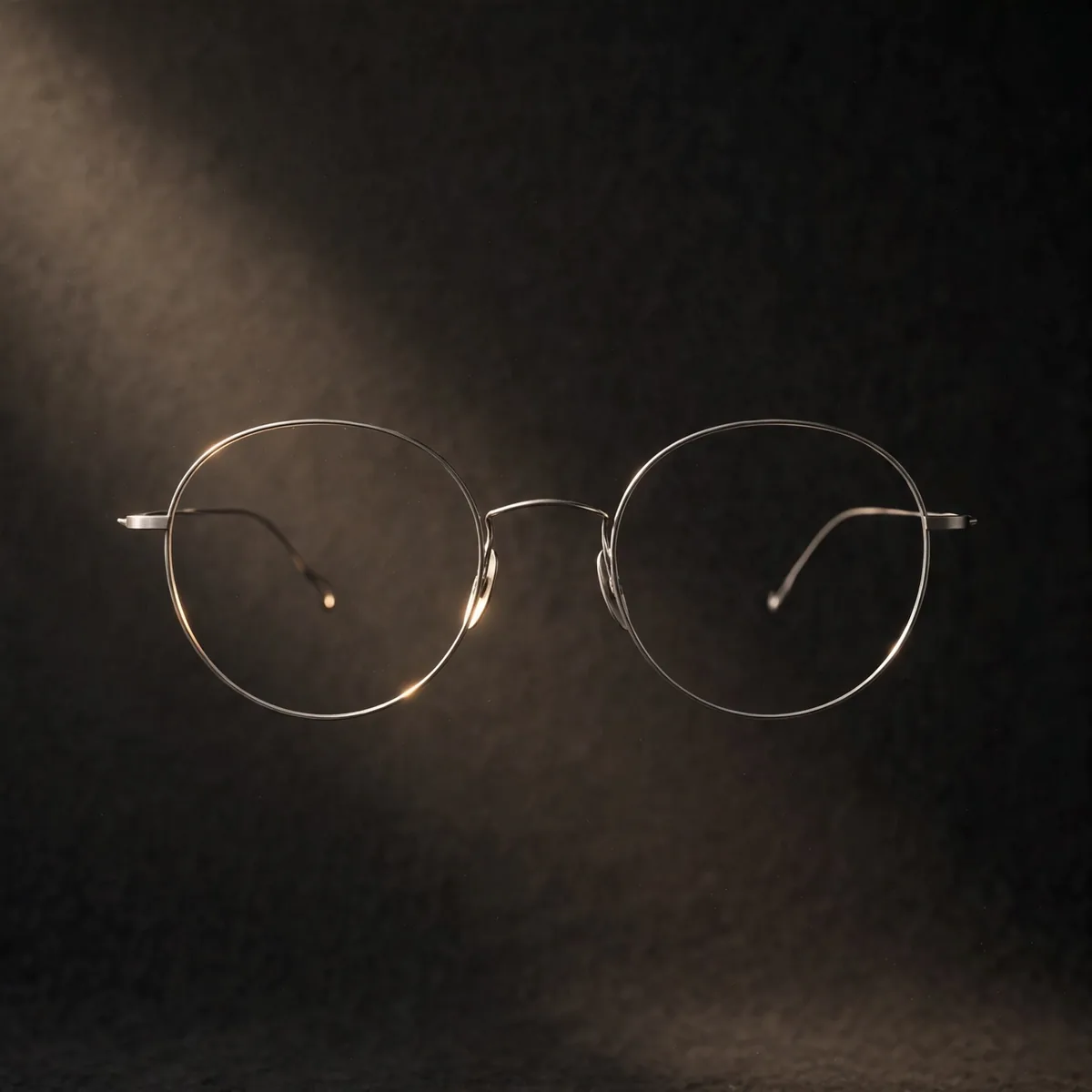
The ingredients are specific. Ultra-light titanium at 18 to 22 grams. Rimless or semi-rimless construction. Hexagonal geometry instead of flashy curves. Cool mineral tones — slate, misty gray, ink blue — instead of shouting colors. No visible branding, or branding so discreet it requires a loupe. Lindberg wrote this playbook years ago; in 2026, half the industry started reading it.
Here's the paradox: restraint requires more confidence than maximalism. Anyone can hide behind huge frames. Wearing nearly invisible glasses means your face does the work. It signals that you don't need accessories to be interesting — you are the interesting thing. That's a power move, and the right rooms know it.
It also ages better. Trends photograph well and date fast. A perfect titanium rimless frame in 2026 will look just as correct in 2036. Cost-per-wear math heavily favors the quiet option, and in a year when premiumization — not volume — is driving the optical industry's growth, the quiet option is increasingly where the smart money goes.
Maximalism is fun. Minimalism is forever. In a maximalist year, forever is the rebellion.
There's one more reason quiet luxury wins in 2026 specifically: the smart glasses era is coming, and the frames that survive it will be the ones that look like frames. A perfect titanium rimless pair can absorb new technology invisibly — sensors, speakers, and chips hide effortlessly in minimal designs. The loudest frames of today may be the hardest to upgrade tomorrow. Restraint is taste, yes — and it is also future-proofing.
In a room full of shouting frames, silence is the loudest voice.
35 BUY. SKIP. WAIT. Single page →
Trend Radar
BUY. SKIP. WAIT.
The 2026 trend scorecard. No hedging, no maybes.
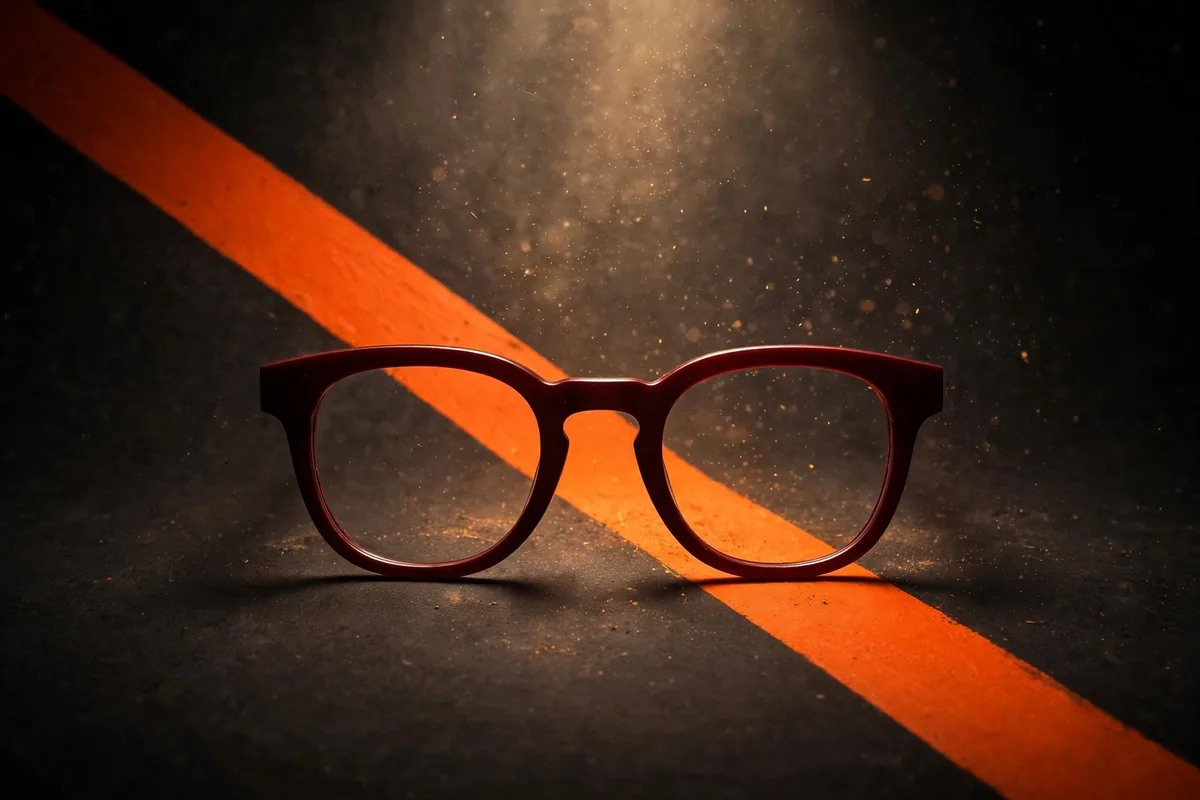
BUY: The rounded rectangle. Straight top, softened corners, flatters everyone — this is the shape of the year and it will outlast the year. BUY: Burgundy and dark tortoise. The deepest, most wearable color story of 2026, backed by MIDO and Pantone's A/W 2026–27 palette. BUY: Smoked crystal and translucent acetate. Light is the most flattering material there is. BUY: The modernized cat-eye — the 15 to 20-degree upturn keeps the attitude and drops the costume. BUY: Fine titanium minimalism. Lindberg-grade restraint never dates.
SKIP: Neon accents hidden inside frames. Cute in a showroom, invisible in real life — you're paying for a detail nobody sees. SKIP: Laser-engraved stone textures at luxury markups unless the craftsmanship is genuinely exceptional. SKIP: Full AR flagships at $2,195 unless you're a developer or a collector. The fashion tier won this year; let the flagships mature.
Buy the frame. Skip the gimmick. Wait on the future.
WAIT: Electrochromic tint-changing lenses — shipping as consumer non-Rx product in 2026 but not yet ophthalmic grade. WAIT: Liquid-crystal autofocus prescription lenses, projected for 2027 after slipping a year. WAIT: Apple's glasses — fashion-first frames with four designs tested, expected 2027. The category will be better and cheaper twelve months from now. WAIT: Bio-acetate at a premium — rising fast, worth supporting, but don't overpay for the label while standards are still forming.
The meta-verdict: buy the shapes and colors, skip the gimmicks, wait on the tech. Your face will thank you.